
Entry to the Chengdu Research Base of Giant Panda Breeding runs on reserved time slots booked through official channels, with the original identity document checked at the gate; giant pandas are most active in the cooler early hours, which is why the first slot is the valuable one
Checked October 2026GUIDES / ITINERARIES
Chengdu in Three Days: Tea First, Pandas Early, One Big Choice
Three days is Chengdu's natural unit: a slow city day to learn its pace, one dawn start for the pandas, and a third day you spend on a single deliberate choice — Bronze-Age mystery, a giant Buddha, ancient waterworks, or simply more Chengdu.
City Chengdu13 min read8 facts labeledChecked 2026-10-30
01 · IN BRIEF
Day one starts at walking pace, on purpose
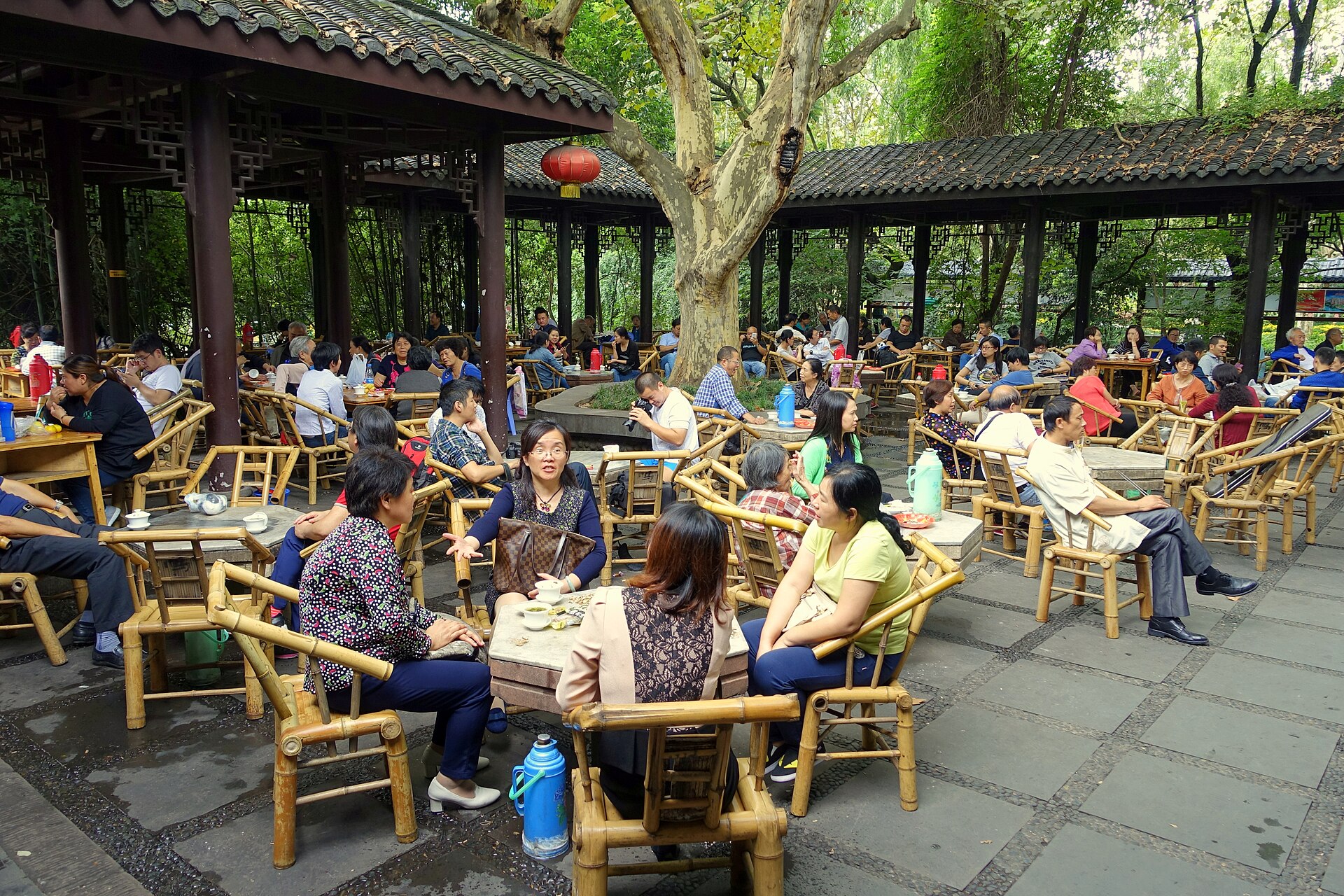
It is half past nine on your first morning and nobody in People's Park is in a hurry. Under the plane trees, a few hundred bamboo chairs hold a few hundred conversations; a waiter crosses the terrace with a long-spouted kettle and fills your covered bowl without breaking stride, and an ear-cleaner with a tuning fork and a headlamp is doing unhurried business two tables away. Your instinct says you are wasting sightseeing time. Chengdu's answer is that this is the sightseeing: a city whose main attraction is a way of spending time, and you have three days to learn it properly.
That is the real design problem of a three-day Chengdu trip. The pandas demand the trip's only dawn start. The region offers four heavyweight excursions that each want a full day. And the city itself — teahouses, lanes, temples, snack streets — punishes anyone who treats it as the gap between trips out of town. This itinerary sequences the three days so each one has a single job: day one teaches the city's rhythm at ground level, day two gives the pandas the early morning they reward, and day three is spent on one complete choice, made with your eyes open, rather than two famous names stitched together by wishful thinking about trains.
02 · SEE IT
The three days, in running order
- Day 1 — Learn the pace: People's Park teahouse by mid-morning, a slow drift through the Shaocheng lanes, lunch, then one anchor — Wenshu Monastery, a museum, or Chunxi Road after dark
- Day 1 evening — The trip's one big Sichuan dinner belongs here, tonight, while tomorrow's early start is still painless
- Day 2 — Pandas first: inside the Panda Base at opening with your booked slot and passport, habitats until the crowds thicken, then back to the centre for food and a genuine rest
- Day 2 evening — Optional only: Sichuan opera if the group is rested; a neighbourhood noodle dinner if it is not
- Day 3, choice A — Sanxingdui: a museum day in Guanghan, Bronze-Age bronzes and gold, home by evening
- Day 3, choice B — Leshan: the giant Buddha by cliff path, boat, or both — the longest walking and transport day of the three
- Day 3, choice C — Dujiangyan and Qingcheng: a 2,000-year-old water system that still works, plus temple stairs only if legs and timetable agree
- Day 3, choice D — The second city day: Wenshu, a museum, a long food route and another teahouse, at human speed
- Sequencing rule — Exactly one early start in three days, and it belongs to the pandas
- Sequencing rule — The heaviest meal never sits the night before the earliest departure
03 · TRY IT YOURSELF
Run the three days like a local would
Your ticks stay on this page only. No account or personal data is sent.
04 · THE PROOF
The facts this itinerary leans on
Sanxingdui Museum stands in Guanghan, outside Chengdu entirely — arriving in Guanghan or at its rail station is not arriving at the museum, and the full hotel-to-gallery chain, plus several hours inside, is what the day actually consists of
Checked October 2026The Leshan Giant Buddha is inscribed by UNESCO as part of the Mount Emei Scenic Area listing, carved into the cliff at the meeting of three rivers — which is why both a cliff-path visit and a boat perspective exist, and why water level and weather can change what is possible on the day
Checked October 2026Mount Qingcheng and the Dujiangyan irrigation system share a single UNESCO inscription: an engineered water system from the third century BC that still irrigates the Chengdu plain, paired with one of China's founding Daoist mountains
Checked October 2026Chengdu runs two airports — Shuangliu (CTU) near the centre and Tianfu (TFU) far to the southeast — and more than one major rail station, so 'the airport' and 'the station' are questions, not answers; mixing them up is the classic Chengdu transfer error
Checked October 2026Jiuzhaigou is not a Chengdu day trip in any honest accounting — it is a separate journey of most of a day in each direction or a flight plus ground transfer, and bolting it onto a three-day Chengdu stay consumes the entire trip
Checked October 2026The teahouse in People's Park — the Heming Teahouse under the trees — is the working symbol of Chengdu's pace: covered-bowl tea, bamboo chairs, ear cleaning and card games, used by residents as daily infrastructure rather than staged for visitors
Checked October 2026Local food decisions in Chengdu are made on Dianping, whose reviews, photos and must-eat lists are how residents shortlist restaurants — a directional signal for where locals eat, useful for picking the one big dinner, not a certified league table
Checked October 202605 · STEP BY STEP
How the three days fit together
- Step 1 — Day one is for arrival in the real sense
However you reached Chengdu, day one belongs to the centre and to learning its speed. Start at People's Park once the morning is underway and give the teahouse real time — an hour of tea under the trees, watching exercise groups, card schools and matchmaking notices do their daily work. The residents are using a public park, not performing; watch respectfully and join the tea, not the staring. Then drift through a limited piece of the Shaocheng lanes nearby, take lunch, and pick exactly one afternoon anchor: Wenshu Monastery's calm courtyards, one of the city museums, or the glass-fronted contrast of Chunxi Road and Taikoo Li. Keep the route directional — a loose line, not a zigzag between photo stops across town. The day exists to teach you the city; repeated cross-town rides teach you only the metro.
- Step 2 — Spend the big dinner on night one
Tonight is when the itinerary's richest meal belongs. You are not yet tired, tomorrow's early start is a fixed slot rather than a dawn expedition, and a proper Sichuan dinner — or the trip's one hotpot — lands better here than after a full excursion day. Keep it composed rather than maximal: one numbing dish, one gentle dish, vegetables, rice. Then an early night without apology. The sequence matters more than the restaurant: the travellers who suffer on day two are usually the ones who treated night one as the celebration and the panda slot as a formality.
- Step 3 — Day two: be at the Panda Base at opening
Arrive for your confirmed slot at the correct gate with the original identity document you booked under. Inside, work from the current map and cover several habitat areas rather than camping at the first enclosure: pandas cannot be scheduled, and the animal asleep in front of you may be next door's headline act in twenty minutes. Cooler morning air helps the pandas and also helps you — the grounds are extensive, the shuttle buses do not erase every walk or wait, and by late morning both the crowds and the heat will be making decisions for you. When one queue starts eating the whole morning, move on; there are more pandas. Leave by early afternoon, eat something simple in the centre, and then rest for real — feet up, not a 'quick look' at another sight.
- Step 4 — Day two evening stays optional, honestly
After the rest, add one calm district at most. A Sichuan opera evening — face-changing, fire-spitting, tea served to your seat — is a reasonable reward for rested adults and a poor idea for the jet-lagged, the heat-struck and most children by their second early night. Give yourself explicit permission to make it noodles and bed. The itinerary has no prize for completing every evening slot; it has a day three that tomorrow-you will be glad to meet awake.
- Step 5 — Day three, choice A: Sanxingdui, the museum day
Pick Sanxingdui if archaeology is the trip's intellectual peak. Book through whatever official channel is current, check which identity documents the reservation demands, and cost out the entire journey — hotel, transfer, Guanghan, the museum's own last leg — before committing. The museum deserves several unhurried hours: build the day around the galleries, a meal and the return, not around squeezing a second sight into the margins. A little preparation pays compound interest here. Skim a basic timeline of Bronze-Age Sichuan beforehand, then let the collection set the agenda in person — pick a few threads, such as the bronze trees and masks, ritual use, or gold work, instead of photographing every label in the building. This is the lowest-walking, highest-density day-three option, and the one that survives bad weather best.
- Step 6 — Day three, choice B: Leshan, the long day
Pick Leshan for scale and setting: a 71-metre Buddha seated in a cliff where three rivers meet, in place for over a thousand years. Decide in advance what your visit emphasises — the cliff path down past the figure, the boat's full-length river view, or both — and check the attraction's official notices for how admission and boat operations currently stand, because water level, weather and queues all reach into this day. Honest accounting again: the train is one component among station transfers, security, onward travel at the far end and the return, and the whole chain is the longest of any day-three option. Wear shoes meant for stone steps, let older travellers choose the gentler version without negotiation, and put nothing fixed and ticketed in Chengdu that evening — a fixed show after Leshan is pressure dressed as planning.
- Step 7 — Day three, choices C and D: working water, or the city again
Pick Dujiangyan if engineering that still functions after 2,200 years fascinates you — and add Qingcheng's temple stairs only if the whole group genuinely wants more climbing and the day's schedule truly supports both, not as a default bundle. Or take the option too many itineraries apologise for: the second city day. Wenshu if you skipped it, a museum in depth, an extended food route, a neighbourhood teahouse that is not the famous one. If the trip so far has been a hard fortnight of sights elsewhere in the country, this is frequently the best day three of all, and it is the automatic answer if day three ends with a flight — especially a Tianfu departure, which can take a substantial bite out of the day before you have gone anywhere.
- Step 8 — Protect the structure, not the checklist
The three days work as a system: rhythm, wildlife, depth. What breaks it is almost always greed in one of three forms — pairing the pandas and Sanxingdui as if both were light starts, treating Jiuzhaigou as a day trip, or stacking hotpot and opera onto the end of the longest day. Hold one indoor backup for rain or extreme heat, let a regional day slide when tickets allow, and never schedule three early mornings. And if you are continuing to Chongqing, that pairing is excellent by high-speed rail — but protect two complete days for Chengdu itself first, and count hotel-to-station time on the way out. Three days feel generous in Chengdu precisely when rest, and the hours spent simply getting places, are written into the plan as ingredients rather than stolen from it.
06 · WHERE THIS BREAKS
Where this plan stops working
Pandas do not perform to itinerary
Animal behaviour is weather, season and mood; a warm afternoon can mean a base full of sleeping pandas at any price of ticket. The early slot is a probability play, not a guarantee — and visitors who accept that enjoy the base, while visitors who demand a show resent it. Cut the route short instead of forcing every habitat in punishing heat.
Children change the arithmetic
The structure suits children — one animal morning, gentle city days — but the longest excursions test small legs and shorter attention. Families should default to the milder day-three options, keep the opera optional in fact rather than in brochure language, and carry snacks and water for the regional day instead of assuming site food will appear when needed.
Two early starts is the fatigue ceiling
Pandas plus an excursion departure makes two dawns in three days, and a late arrival the night before silently makes it three. If you land in Chengdu late, swap days one and two or move the panda slot — the itinerary is an order of priorities, not a contract, and it explicitly tolerates swapping the city day and panda day when tickets or weather require it.
Departure days are not excursion days
If day three ends with a flight or a long train, the regional options shrink fast. Tianfu Airport in particular is a serious transfer from the centre; Shuangliu is kinder. A flexible city day before a fixed international departure is not a wasted day — it is the version where you actually catch the plane unhurried.
Is three days actually enough for Chengdu?
For the city's own argument, yes: one day of rhythm, one of pandas, one of depth covers what Chengdu claims to be. What three days cannot do is Chengdu plus its whole region — Leshan, Sanxingdui, Dujiangyan, Qingcheng and a slow city day are five days' worth of day three. The plan works because it chooses; a version that refuses to choose is a five-day itinerary wearing a three-day label.
07 · KEEP READING
Keep the trip moving
 Chengdu · DoChengdu in 2 Days: Pandas Before Breakfast, Tea After LunchChengdu punishes itineraries and rewards rhythms: one anchor per half-day, an early panda morning, and long afternoons that end in hotpot.Reference ~
 Chengdu · DoChengdu Panda Base the Low-Stress Way: Opening Time, Passport Tickets and the Morning RouteOpening time, a passport-matched ticket, nurseries first: the panda base rewards exactly one strategy, and this is it.Reference ~
 Chengdu · DoChengdu First Time: Pandas Early, Tea Slow, Everything Else AfterOne protected morning with the pandas, one long afternoon in a park teahouse, and a city that rewards you for not rushing — how a first Chengdu trip actually fits together.Verified
08 · SOURCES
Sources and status
Prices, schedules and booking channels change. Recheck the details that matter before you travel.
- Sanxingdui Museum — official siteVerifiedOfficial channel for current ticketing and identity requirements; checked 2026-10-30
- UNESCO — Mount Emei Scenic Area, including Leshan Giant Buddha Scenic AreaVerifiedInscription and site description for the Leshan day option; checked 2026-10-30
- UNESCO — Mount Qingcheng and the Dujiangyan Irrigation SystemVerifiedInscription and site description for the Dujiangyan/Qingcheng day option; checked 2026-10-30
- Dianping (Chengdu restaurant reviews and must-eat lists — local demand signal)Reference ~Local-signal patterns as described; no rankings reproduced or relied on; checked 2026-10-30