
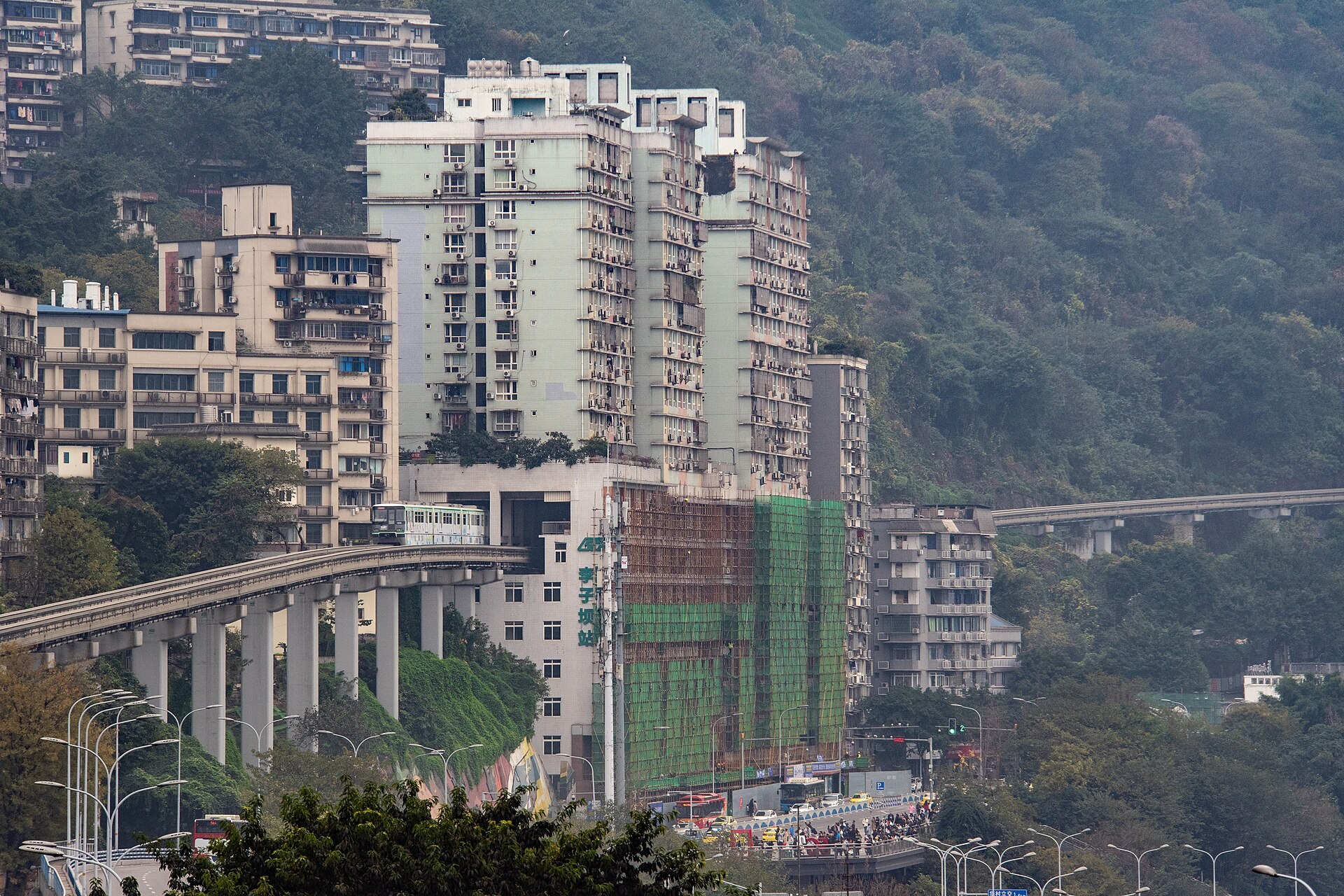
Liziba station on rail Line 2 passes directly through a residential building — the station occupies the middle floors of a block that was designed and built together with the line, not punched through afterwards. Trains pass every few minutes in service hours, so the viewing platform works as a short stop, not a vigil
Checked October 2026GUIDES / ITINERARIES
Chongqing in 2 Days: Walk Downhill, Ride Through the Building
In Chongqing you plan by floor, not by distance: a monorail through a living room block, one honest climb, a lit cliff after dark, and stairs treated as the sightseeing itself.
City Chongqing13 min read9 facts labeledChecked 2026-10-29
01 · IN BRIEF
The city where 'you have arrived' is a lie
Your phone says you have arrived. The blue dot sits exactly on your hotel, the distance reads zero metres — and there is no hotel. There is a railing, a drop, traffic noise coming from somewhere underneath you, and a local who points helpfully downward: your lobby is twelve floors below the street you are standing on, which is itself the roof of something else. Welcome to Chongqing, the city where 'ground floor' is a matter of opinion.
Two days here works when you stop planning by distance and start planning by level. Day 1 rides the monorail through a residential building at Liziba, climbs once to the Eling ridge for the two-river view, then drifts downhill to Jiefangbei and the lit cliff-face of Hongyadong after dark. Day 2 picks one of two classic Chongqing mornings — Ciqikou old town early, or the Yangtze Cableway across to a slow Nanbin Road afternoon — and ends where Chongqing days are supposed to end: at a hotpot table. The stairs are not an obstacle to this itinerary. They are the itinerary.
Hold the two days to different jobs. Day 1 is the physical city — height, stairs, rivers, the shock of the place. Day 2 is the explanation: the rail, the museum context, one modern district, the contrast that makes Day 1 legible. If heat or rain makes a hillside block unsafe, trade the indoor and outdoor pieces between the days instead of deleting either; the plan bends, it does not collapse.
02 · SEE IT
Two days at a glance
- Day 1 · Morning — Start high in the central peninsula, one downhill old-city corridor · Afternoon — South-bank lanes, the riverfront, or an honest rest · Evening — A single lit-city viewpoint, then hotpot
- Day 2 · Morning — Liziba with one compatible block beside it · Afternoon — Guanyinqiao, the Three Gorges Museum, or an easy river stretch · Evening — Noodles, a short walk, an early finish
- Day 1, morning — Liziba: ride Line 2 through the building, then watch it from the platform below
- Day 1, late morning — Eling ridge: the two-river view that explains the whole city
- Day 1, afternoon — Descend in stages toward Jiefangbei; temple shade, cold drinks, no heroics
- Day 1, evening — Jiefangbei at dusk, Hongyadong after dark — viewed from the bridge or the far bank
- Day 2, morning — One choice only: Ciqikou old town by 9:00, or the Yangtze Cableway across to Nan'an
- Day 2, afternoon — Nanbin Road: the level riverfront, the skyline across the water, a slow hour
- Day 2, evening — The hotpot finale at a neighbourhood pot near the hotel
03 · TRY IT YOURSELF
Book these ahead — the short list
Your ticks stay on this page only. No account or personal data is sent.
04 · THE PROOF
The facts this plan leans on
Hongyadong is an 11-level complex built into the cliff between the upper road at Jiefangbei level and the river road far below. The famous night photograph is of its lit exterior — taken from the Qiansimen Bridge or the opposite bank of the Jialing River — not of anything inside it
Checked October 2026The Yangtze Cableway crosses between the Yuzhong peninsula and Nan'an district in a few minutes and runs on timed tickets sold through official channels; at peak times the queue, not the ride, is the cost — waits past an hour are reported on busy weekends
Checked October 2026Chongqing is one of China's hottest, most humid summer cities: July and August afternoons regularly sit in the high 30s °C, and the stair routes between levels turn that heat into the day's real constraint
Checked October 2026In the peninsula, a single metro station can have exits opening at very different elevations, and a hotel '200 metres away' on the map can be a dozen floors below you. Locals navigate by named exits and levels, not by distance
Checked October 2026The China Three Gorges Museum, facing the People's Great Hall in Yuzhong, is the context machine for the whole trip: the two rivers, the region's history, and the enormous infrastructure changes that reshaped both. Admission rules, ID requirements and closure days shift — confirm them before building a day around it
Checked October 2026Day 2's other lever is contrast. Guanyinqiao is contemporary commercial Chongqing — malls, local chains, everyday crowds. Shapingba carries a younger, university-and-history weight. A single district, walked slowly, explains the modern city better than three more photo stops on the peninsula
Checked October 2026A Chongqing river evening has four candidate headliners — the lit Hongyadong cliff, a Nan'an-side perspective, a cableway crossing, a night cruise — and they are alternatives, not stages of one evening. Choose a single primary plan and hold the rest as weather backups
Checked October 2026The meal distribution that keeps two stair-heavy days upright: hotpot exactly once, timed for when the hardest walking is already behind you; noodles, rice dishes and smaller plates in the other slots; restaurants chosen where the route ends rather than across a river for a viral name; chilli heat and numbing pepper specified as two separate dials; and nothing enormous late on the night before an early train
Checked October 202605 · STEP BY STEP
Day by day
- Day 1, morning — Liziba: ride it, then watch it
Do Liziba in both directions of looking. First, ride Line 2 and sit toward the front as the train slides into the building — the passenger view, gone in seconds. Then leave the station, follow the signs down to the designated viewing platform below, and watch the next trains come through the block from outside. Thirty to forty-five minutes total is the honest dose; trains run a few minutes apart, so never burn an hour waiting for a perfect frame. The common failure is following a flat map pin to a roadside at the wrong level — use the signed exit route, not the pin.
- Day 1, late morning — Eling: the one climb of the day
From Liziba it is a short hop to the Eling ridge, the natural high spine of the peninsula. Eling Park's tower and terraces give the orientation shot the whole trip leans on: the Jialing River on one side, the Yangtze on the other, and the peninsula's stacked streets in between. If you want a coffee with the view, the old factory courtyards of the Eling creative park nearby do exactly that. You climb once, early, while the heat is still negotiable — everything after this is descent.
- Day 1, afternoon — Descend in stages, rest on purpose
Drift down toward Jiefangbei in stages — metro hops and short downhill walks rather than one heroic staircase descent. This is the heat-management block: duck into Luohan Temple, a centuries-old temple improbably folded between towers, for thirty quiet minutes, or take a long cold drink somewhere with serious air conditioning. Eat noodles early if you are hungry. A Chongqing afternoon spent fighting the sun on stairs is an evening ruined. Keep it to one corridor, and know where it lets you out: the classic error is bolting a second trending stair district onto the route because it looked close on a flat map. Finish the descent somewhere with a lawful exit — a metro entrance, or a road where a car is allowed to stop. If the afternoon still has legs, a south-bank historic-lane block continues the old-city story at river level; if it does not, rest without apology. Rest is a routing decision in this city, not a surrender.
- Day 1, evening — Jiefangbei and Hongyadong, from the right side
Reach the Jiefangbei clock tower as the light goes, eat something unambitious nearby, and time Hongyadong for after dark, when the cliff complex switches on. Now the honest part. Inside, Hongyadong is mostly crowded food-court floors, souvenir lanes and a famous-name scrum at the entrances — walk it if you like, entering from the top level and exiting at river level, but know that the thing in the photograph is the building itself. The places to actually stand are outside it: the pedestrian side of Qiansimen Bridge looking back at the lit cliff, or across the Jialing near the Grand Theatre, where the whole stack reflects on the water. Afterwards, do not join the taxi melee at the river-road entrance; walk a block or two to a side street at a level with moving traffic and order a car there.
- Day 2, morning — Pick one: Ciqikou early, or the cableway across
Option A is Ciqikou, the old porcelain-port town on the Jialing in Shapingba: stone-flagged lanes, teahouses, snack stalls, a temple above the river. Its one rule is the clock — arrive around 9:00, while the lanes still belong to residents and breakfast stalls, and be leaving by 11:00 as the tour groups pour in. Option B, the better default on a clear day, is the Yangtze Cableway: book a timed one-way ticket from the Yuzhong side across to Nan'an in the morning, ride it once (one-way is enough; the return is a metro bridge away), and let it deliver you to the south bank for the afternoon below. Choose tonight, not at breakfast — the cableway option needs its ticket booked ahead.
- Day 2, afternoon — Nanbin Road, the level reward
The swap option first: if the morning went to Ciqikou, or the weather has turned, give this block to the China Three Gorges Museum instead — two rivers' worth of gorges, regional history and dam-era reshaping that makes everything you have been staring at suddenly legible — or to Guanyinqiao, for the contemporary answer of malls and local chains. Otherwise: Nanbin Road runs along the south bank facing the peninsula, and it is where Chongqing exhales: a long, level riverfront (a mercy after yesterday), coffee and tea stops, and the full skyline standing across the water doing its impression of a circuit board. Walk a stretch of it, sit for an hour of it. If you took Ciqikou instead this morning, spend this block the same way on whichever riverfront is near you — a slow afternoon is a scheduled item in this city, not a gap. Save Chaotianmen, where the two rivers meet at the tip, for a short look if energy remains; it pairs naturally with the walk back toward Jiefangbei.
- Day 2, evening — The hotpot finale, near the hotel
Close with hotpot, and close properly: a neighbourhood old-house pot near your hotel rather than a famous chain across town — tonight's navigation budget is spent. If this is your first Chongqing pot, order it one spice notch below what you think you want (our food guide explains why the local ladder runs hot) and let the table order in waves. Tomorrow-you, facing a departure on a stomach at peace, will be grateful. This is the finale the whole two days were paced for. One big pot across the two days is the design rather than a compromise: if you already spent it after Day 1's walking — the other sanctioned layout — then tonight is deliberately quieter: noodles near the hotel, a short level walk, an early finish. Do not run the same lit-cliff evening twice from opposite banks.
06 · WHERE THIS BREAKS
When this plan breaks — and the fix
Heat, humidity, and the fog season
In July and August, midday stair routes in full sun are a genuine health risk, not a discomfort. Shift both days' anchors to morning and evening, treat the afternoon as indoor or transit time, and carry water plus electrolytes. In the foggy, drizzly months the opposite problem appears: the skyline and the Hongyadong view can wash out entirely — swap the evenings rather than forcing a viewpoint in the murk.
Stair fatigue is cumulative
Chongqing step counts compound invisibly: every 'short walk' hides flights, and by Day 2 afternoon knees file formal complaints. Anyone with knee or mobility issues should rebuild this plan around metro hops and short level walks, skip Ciqikou's cobbled slopes, and take the cableway-and-Nanbin option as the default rather than the alternative.
Spice accumulation over two days
Do not run full-strength mala at lunch and dinner on both days. The chilli-and-pepper load builds across 48 hours and ends trips early. Escalate gradually — a mild-by-local-standards first pot, the serious one as the Day 2 finale — and keep one plain meal (wontons, rice dishes, a clear soup) in each day as ballast.
Hongyadong on a holiday night
On holiday evenings the Qiansimen Bridge walkway and the plaza under Hongyadong compress to a shuffle, and the 'viewpoint' becomes other people's shoulders. If crowds undo you, take the same lit cliff from the Nanbin or Jiangbei side of the river, where the view is wider and the density is a fraction — or shift the Hongyadong evening to a weekday.
The cableway is not guaranteed
The cableway stops for high wind and maintenance and queues hard at peak; a timed ticket reduces but does not delete the wait, and the ride itself is only a few minutes. Treat it as a delightful hop, not a load-bearing connection — the metro crosses the same river on a bridge, and the Nanbin afternoon works identically if you arrive by train instead of by air.
Wrong level, right address
The single most common Chongqing failure is arriving at the right coordinates on the wrong floor: a Liziba exit that lands you on a roadside, a hotel entrance one level under your taxi, a restaurant pin at the top of a staircase you cannot see. Confirm the exact metro exit name and the level of every entrance before you set out, and when lost, ask for the level, not the direction.
Should I add Wulong?
Only by handing it almost the whole of Day 2. Wulong is a full regional excursion — intercity transport, a separate scenic-area entry, and serious walking of its own — so taking it deletes Liziba, the museum and the slower districts. On a first trip you will learn more about Chongqing from two days inside the city itself. Bring Wulong in when the karst is the point of the whole China journey, not as a bonus bolted onto a weekend.
Is two days enough here?
Enough for the core: the stacked central terrain, both rivers in view, the food, and one museum or modern district done properly. Not enough for a relaxed regional excursion on top. Treat two days as a first understanding of the city, not a completion certificate.
Can Liziba fit without eating a morning?
Yes, when it rides along with transport you are already taking and the block next to it. Ride through the building, use the designated viewing platform briefly, follow the crowd controls, keep out of the traffic lanes and out of residents' doorways — and leave once you have watched two or three trains. It turns expensive only when run as its own expedition across town, with an open-ended wait for one perfect frame.
Will the cableway definitely run?
No. Operations, ticket release and queue length all move with weather and season, so confirm the day's running status before promising anyone the ride, and keep a river-view alternative warm. The crossing is a delight, never a load-bearing plan.
Families and older travellers: shrink, don't squeeze
Build from one short downhill route and one museum block, and buy vehicle transfers for the final climbs instead of ending days on stairs. Keep late viewpoints to one night, not both. At Liziba, stay on the official platform, and go once the child has watched a train pass — no photograph earns a long roadside wait. Verify the hotel's lift actually reaches your floor, and protect a mid-afternoon rest on Day 1, because the night view quietly stretches the walking day.
The five classic two-day failures
Walking the same steep corridor twice for day photos and night photos. Reading every metro station as a single street level. Trying to stack every river attraction into one evening. Adding Wulong without removing anything. And siting both main meals far from where the day ends, so dinner itself becomes a cross-river expedition.
07 · KEEP READING
Keep the trip moving
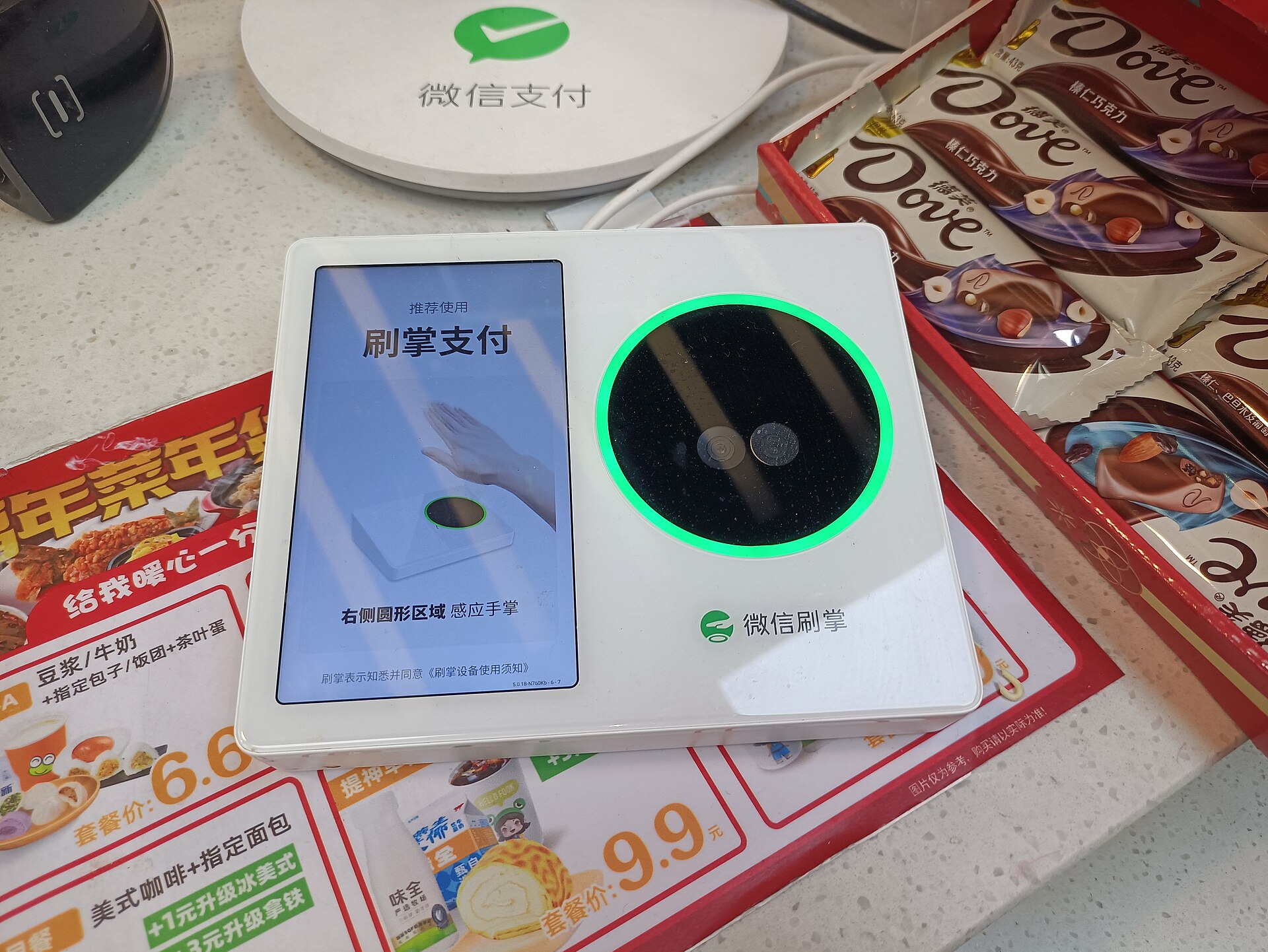 China · PrepareHow to Pay in China (2026): Alipay, WeChat Pay, TenPayGo, Cards and CashSet up one wallet before you fly, add a second as backup, and understand the two numbers that explain most payment confusion.Reference ~
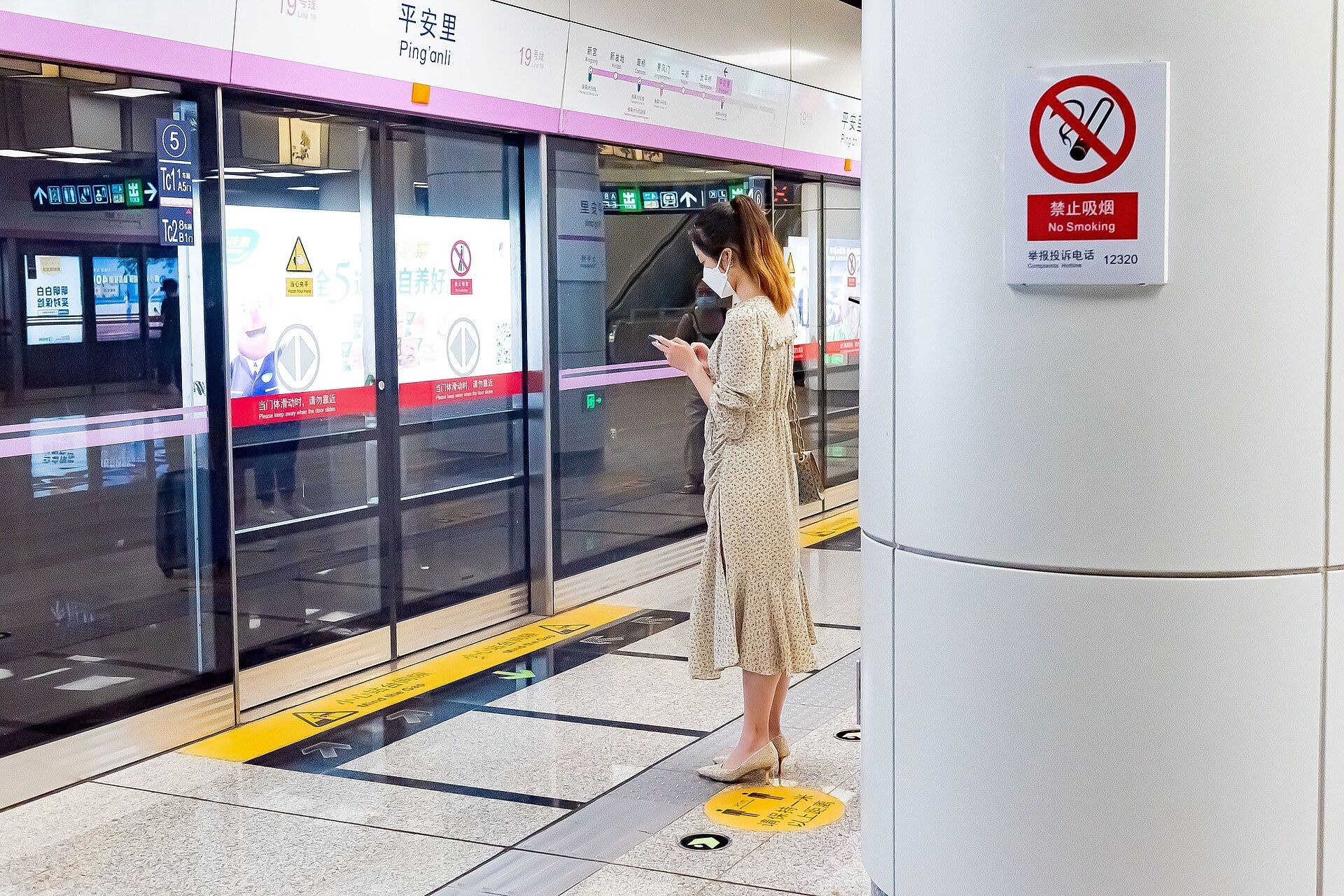 China · PrepareInternet & eSIM in China (2026): Roaming, Travel eSIM, Local SIM and Wi-Fi ComparedYour phone will work in China. The real question is which internet it connects to — every connectivity choice is a choice between two exits.Reference ~
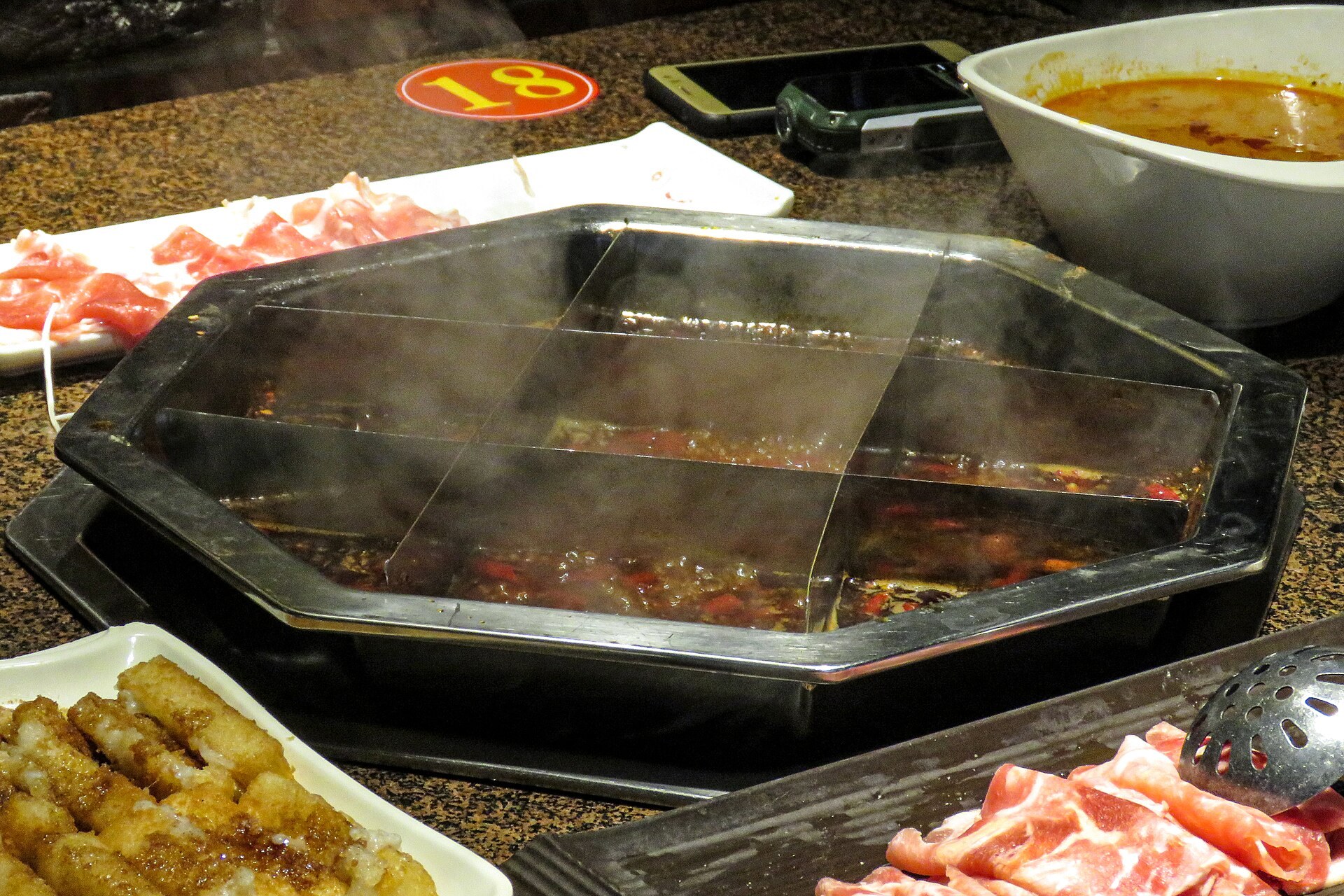 Chongqing · DoChongqing Food Guide: Hotpot in Its Home CityButter-and-chilli broth, a nine-grid clock in the pot, a breakfast noodle with no interest in subtlety — hotpot in its home city, plus the dishes that carry the days between pots.Reference ~
08 · SOURCES
Sources and status
Prices, schedules and booking channels change. Recheck the details that matter before you travel.
- Chongqing Rail Transit — official siteReference ~Check Line 2 service notices and Liziba station exit arrangements for your date
- Chongqing municipal government — culture and attractions pagesReference ~Official channel for current visitor information, admission and closure notices — confirm day-specific details here