
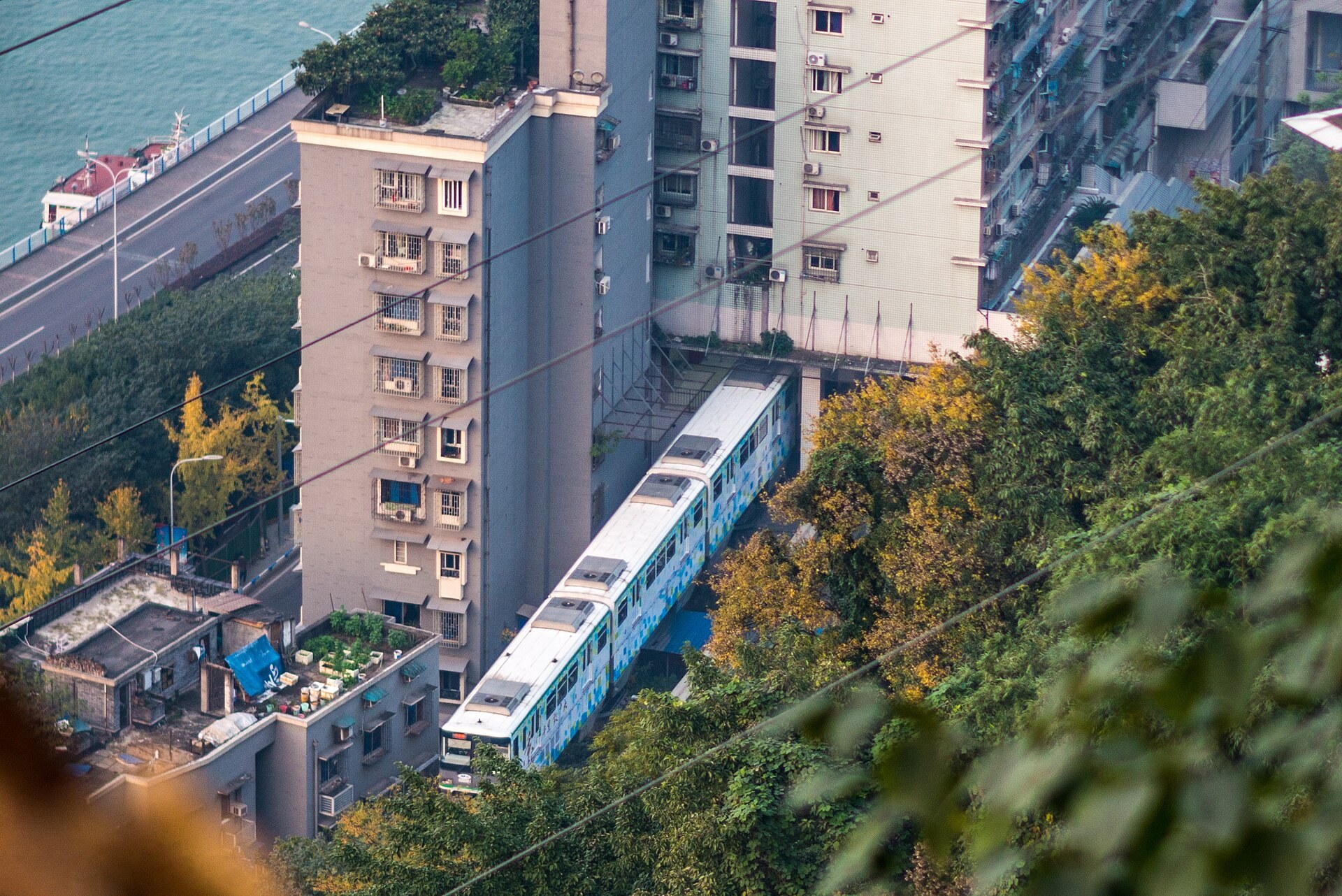
Liziba is a working station on Chongqing Rail Transit Line 2, threaded through a residential tower above the Jialing riverbank; the designated public viewing platform sits at street level below the station, separate from residents' space
Checked 29 October 2026GUIDES / CITY WALKS
Chongqing Mountain City Walk: Liziba, the Crown Escalator and the Shibati Steps — Mostly Downhill
One ridge-to-river walk through the stacked city: a train through a tower, an escalator instead of a staircase, a square that is somehow the 22nd floor, old-town steps, and two rivers meeting in two colours.
City Chongqing14 min read8 facts labeledChecked 2026-10-29
01 · IN BRIEF
The city your map cannot see
A traveller we followed in Yuzhong stood on a wide, ordinary-looking plaza, phone in hand, while the app insisted she had arrived. The restaurant was indeed at that pin — roughly twenty floors straight down, on a street she could see but not reach without a lift, two staircases and a local's directions. In Chongqing the shortest line between two points is often vertical, and 'you have arrived' is where the navigation problem starts, not where it ends.
This walk turns that problem into the day's entertainment. It strings the famous vertical set pieces into one line that runs mostly downhill: begin on the ridge at a converted factory, drop to the Liziba platform to watch a train thread a residential tower, ride a commuter escalator instead of a staircase, cross a square where ground floor means two different heights, descend the old Shibati steps, and finish where the Jialing flows into the Yangtze. Gravity does the work; the metro does the climbing on the way home.
02 · SEE IT
The route, high to low
- Start high: Eling Testbed No.2 (Erling Erchang), the converted printing factory on the ridge — galleries, cafés and a skyline terrace
- Drop to Liziba: watch Line 2 dive through the tower from the street-level viewing platform, then ride through the building yourself
- Line 2 to Lianglukou, then the Crown Escalator down — a paid transit escalator locals commute on
- The mid-level stack: Kuixinglou square, where one side's ground floor is the other side's 22nd floor
- Shibati: the old town's restored staircase quarter, descending lane by lane toward the lower city
- Finish low at Chaotianmen: the Jialing and Yangtze meet in two colours, and the metro home is at your level
- Map words to save — 上新街站1号口 / Shangxinjie Exit 1: the station-side approach most local write-ups use for Xiahaoli; on the day, follow the signs and check which step-free exit is actually open
- Map words to save — 下浩里1号出入口 / Xiahaoli Entrance 1, where the lanes begin up top; before committing, make sure the path ahead descends instead of bouncing straight back up
- Map words to save — 下浩里3号出入口 / Xiahaoli Entrance 3: the lower finish of the published local route; settle which onward connection you want before drifting out of the lanes
- Map words to save — 龙门浩老街 / Longmenhao Old Street: the optional old-street extension by the river; weigh your remaining energy, opening access and where a car can legally collect you before adding it
- Xiahaoli route, stage 1 of 4 — Shangxinjie arrival: sort out the right exit and your level before moving · about 15 minutes
- Xiahaoli route, stage 2 of 4 — the descent: brick lanes, framed views, steps and restored interiors · 60 to 90 minutes
- Xiahaoli route, stage 3 of 4 — Longmenhao: old-street stretches opening onto broad river views · 45 to 60 minutes
- Xiahaoli route, stage 4 of 4 — river finish: sunset light, bridge views, food or a ride home · 30 to 60 minutes
- Xiahaoli route, total: allow two to three hours, longer with a meal or a sunset finish — and grippy shoes are not optional
03 · TRY IT YOURSELF
Set up before you start
Your ticks stay on this page only. No account or personal data is sent.
04 · THE PROOF
What the route rests on
The Crown Escalator at Lianglukou is one of the longest single escalators in Asia — roughly 112 metres long, climbing on the order of 50 vertical metres in a ride of about two and a half minutes, for a small fare
Checked 29 October 2026Shibati was for generations the staircase link between Chongqing's upper and lower town; the quarter was rebuilt and reopened as a restored historic district in 2021, keeping the stepped lanes as its spine
Checked 29 October 2026Eling Testbed No.2 (Erling Erchang) is a former banknote-printing factory on the Eling ridge, converted into a creative park of galleries, studios and cafés with open skyline terraces
Checked 29 October 2026At Chaotianmen the Jialing River joins the Yangtze; the two flows often stay visibly different in colour for some distance downstream, with the contrast strongest when the rivers carry different sediment loads
Checked 29 October 2026Even sequenced downhill with escalator and metro saves, the full route involves several hundred steps in total across Liziba's approaches, the mid-level streets and Shibati
Checked October 2026Local route reports consistently send walkers in at Shangxinjie, high up, and down through Xiahaoli's lanes to Longmenhao and the water; walked in reverse, the same route stops being scenery and becomes a staircase workout
Checked 29 October 2026Amap lists Xiahaoli Entrance 1 a short hop from Shangxinjie station's Exit 1, and local route documentation threads the walk from that top entrance down to Entrance 3 — treat it as a reference for the route's shape only, since construction, queues and individual businesses change without notice
Checked 29 October 202605 · STEP BY STEP
Walking it, step by step
- Begin on the ridge: Eling Testbed No.2
Ride Line 1 or Line 2 to Eling station and walk up to the old printing factory. Give it an unhurried hour: the galleries are fine, but the real exhibit is the terrace — the whole walk laid out below you, Liziba's tower on the river bend, the peninsula stacked beyond. Orient yourself here, because every later stop is a descent from this height.
- Liziba: platform first, train second
Walk down from the ridge to the signed viewing platform at street level below Liziba station and watch two or three trains pass through the tower — from here you see the whole trick, track entering one face of a lived-in building and leaving the other. Then go up into the station and ride Line 2 through the building yourself. Order matters: the ride-through lasts seconds, the platform view is the one you came for.
- Take the Crown Escalator down
Ride Line 2 one stop to Lianglukou and follow signs for the Crown Escalator. This is not a mall escalator — it is a piece of public transport that locals use to commute between levels, with a small fare and a ride of about two and a half minutes that replaces a long stair climb. Stand right, let commuters pass, and enjoy the one staircase in Chongqing that climbs itself.
- Cross the mid-level stack at Kuixinglou
From the escalator's lower end, walk the mid-level streets toward the Jiefangbei area and Kuixinglou square. Stand at the square's edge: on one side you are on a ground-floor plaza beside a road; on the other, the same level cantilevers out at what the building below counts as its 22nd floor. This is the stop that explains the city — residents' 'ground' is wherever their street happens to be.
- Descend Shibati slowly
Enter Shibati from its upper end and take the stepped lanes down at wander pace — restored houses, snack stalls, small museums worked into the old fabric. The quarter is a staircase that became a neighbourhood, so treat it as both: keep to one side on the narrow flights, rest on the landings, and let the descent set the rhythm. If knees object, shorten here — the lower lanes repeat the upper ones' charm.
- Finish at Chaotianmen, leave from the low city
End at the Chaotianmen waterfront where the two rivers meet; late afternoon into dusk is the best light, when the Hongyadong cliff complex across the inlet starts to glow. Then simply leave at this level — Chaotianmen's metro station (Lines 1 and 6) and the lower riverside road's taxis are right there. The walk is designed to be abandoned at the bottom.
- The Nan'an alternative: Xiahaoli down to Longmenhao
If you would rather walk lived-in lanes than headline set pieces, cross to the Nan'an bank and run the second downhill route. Start at Shangxinjie station, take Exit 1, and find Xiahaoli Entrance 1 on the upper side; pause at the top and orient yourself to the river's level before dropping in. The descent deserves an unhurried hour to ninety minutes: old brick walls, steep lanes, skyline views framed between rooftops, restored storefronts and the traces of families who never left. Spend your time on the turns between the marked viewpoints — the lanes reveal their bridges and towers gradually, and there is no single photo wall worth queueing for. Below the lanes, Longmenhao Old Street stretches the mood out with wider river outlooks for another forty-five minutes to an hour; then stop at river level for sunset, bridges and food, thirty to sixty minutes more. Riding back up by taxi, metro or a public lift is part of the design, not an admission of defeat. Do not bolt this whole route onto the Mountain City Trail and Shibati in a single day unless your group is actively hungry for a long, stair-heavy outing.
06 · WHERE THIS BREAKS
When this walk breaks
Heavy rain changes everything
Wet stone steps at Shibati and on the mid-level lanes get genuinely slippery, and river fog can erase both the confluence colour split and the ridge views. In heavy rain, invert the day: Testbed No.2's indoor galleries and cafés first, metro between stops, and Shibati only if it clears.
Flat-map apps will lie to you
Navigation apps measure horizontal distance on a flat plane. A pin '200 metres away' may be twenty floors below you, and the suggested walking route can route you over a cliff edge that is actually a building. Navigate by station, exit and level; when lost, ask which floor you need, not which direction.
It is not a step-free route
The escalator and metro remove the big climbs, but Shibati's through-route is stairs, and Liziba's platform involves short stepped approaches. Travellers who cannot manage steps should run the reduced version — Liziba platform, Crown Escalator, Chaotianmen waterfront — which keeps the three best vertical moments with far fewer stairs.
The Liziba platform packs out
On weekends and holidays the viewing platform fills shoulder-to-shoulder and the photo becomes a queue. The trains run every few minutes all day; the view at 9:00 on a weekday is identical and empty. Do not build the day around a midday slot here.
Escalators and lifts go down for maintenance
The Crown Escalator occasionally closes for maintenance or runs one direction only. If it is shut, stay on the metro between Lianglukou and the lower levels and take a taxi for the final level change — do not substitute the long public staircases beside it unless you actually want the workout.
Which way should you walk Xiahaoli?
Downhill, full stop. Enter from the Shangxinjie side, up high, and let the lanes carry you toward Longmenhao and the river. When the walking is done, regain your height with a lift, the metro or a taxi rather than retracing hundreds of steps.
How much time does the Xiahaoli walk need?
Budget two to three hours for the comfortable version — photographs, a drink, no rushing. Add more if you linger along the river or stay out for sunset.
Strollers, knees and balance
Families should shorten either route and leave the stroller at the hotel: the lanes and the old-town steps were not built for wheels. Anyone with knee or balance concerns does better walking only the lower lanes, or stitching levels together with vehicle pick-ups between them.
07 · KEEP READING
Keep the trip moving
 China · PrepareHow to Pay in China (2026): Alipay, WeChat Pay, TenPayGo, Cards and CashSet up one wallet before you fly, add a second as backup, and understand the two numbers that explain most payment confusion.Reference ~
 China · PrepareInternet & eSIM in China (2026): Roaming, Travel eSIM, Local SIM and Wi-Fi ComparedYour phone will work in China. The real question is which internet it connects to — every connectivity choice is a choice between two exits.Reference ~
 Chongqing · PrepareChongqing 240-Hour Visa-Free Transit (2026): Jiangbei Airport, the Clock, and a Stopover Worth TakingTen days in China without a visa, through one of its most vertical cities — if your passport is listed, your route is a real transit, and you count the days the way the border does.Verified
08 · SOURCES
Sources and status
Prices, schedules and booking channels change. Recheck the details that matter before you travel.