
Dongba paper belongs to a living Naxi papermaking tradition: local accounts of the craft describe bark being prepared, pulped and lifted into sheets by hand, and workshops in the Lijiang area still demonstrate stages of the process
Checked October 2026GUIDES / SHOPPING
Lijiang Souvenirs: Start With a Sheet of Dongba Paper
The old town sells everything, but only a few things actually say Lijiang: handmade bark paper from a living Naxi craft, workshop goods with a named maker, and regional food chosen by its label rather than its storefront.
City Lijiang11 min read8 facts labeledChecked 2026-10-30
01 · IN BRIEF
The manuscript that was made last month
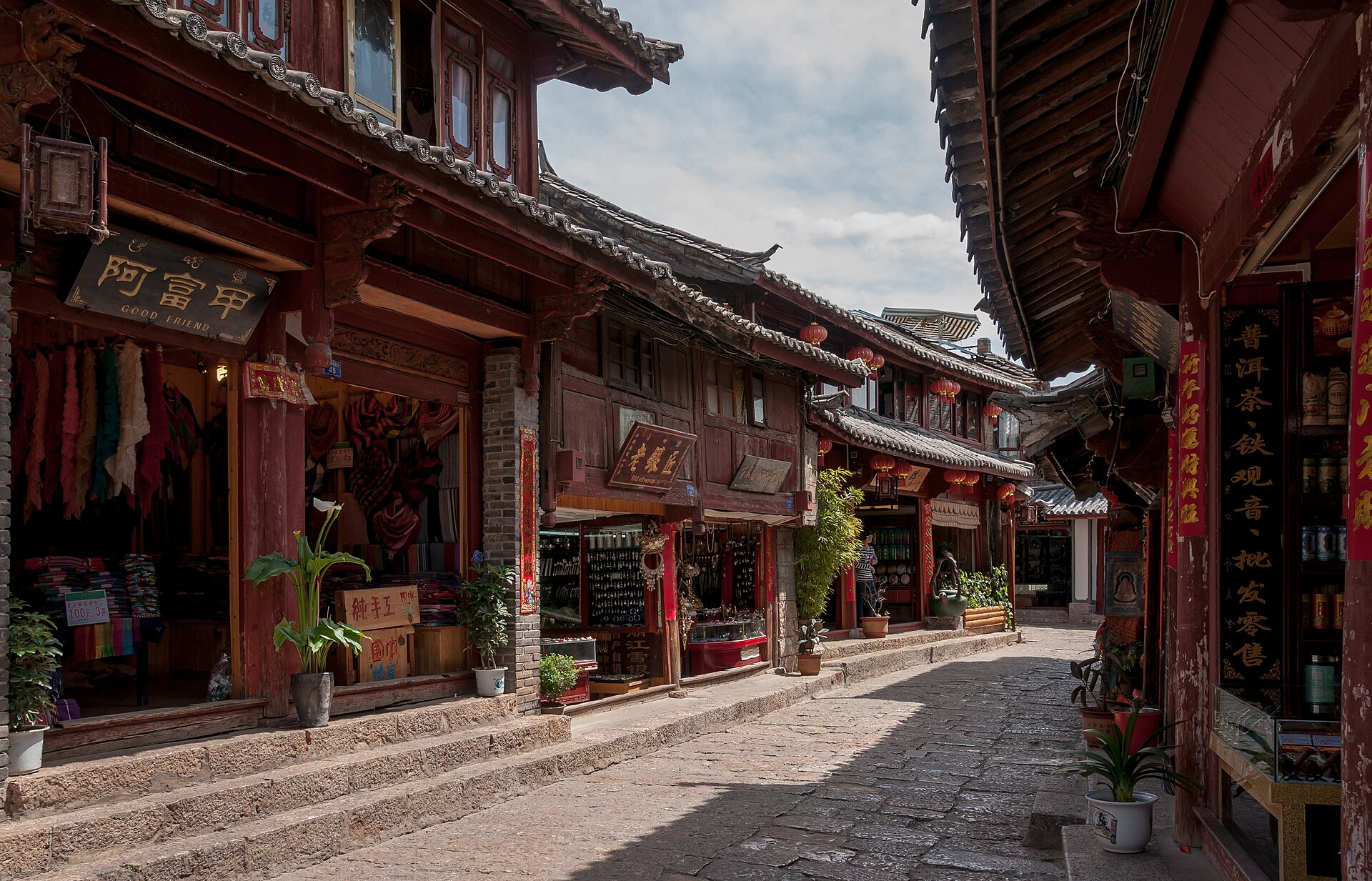
On a lane off Sifang Square, a shopkeeper unrolls a crackling sheet covered in pictographs, holds it up to the light so the fibres glow, and lets the word antique hang in the air. The paper is rough, uneven, faintly golden — it looks exactly like something that should be centuries old. Two doors further down, past a rack of woven scarves, another doorway opens onto wooden frames stacked with pulp: this is where sheets like that one are actually born, bark soaked, beaten and lifted by hand, then dried against a warm wall. The first shop is selling you a story about age. The second is selling the craft itself, still alive, still being practised by Naxi papermakers this week.
That gap — between an object with a maker you can meet and an object with a legend you cannot check — is the whole souvenir question in Lijiang. This guide works through the short list that survives it: Dongba paper first, then contemporary craft with a name attached, then Yunnan coffee and the region's teas and pastries, each judged by what its label can prove rather than by where its shelf happens to stand.
02 · SEE IT
The short list, in the order to shop it
- First — A small Dongba paper piece: a notebook, a single sheet, a print you watched being described by its maker
- Second — One contemporary craft object with a name on it: a ceramic, a carved piece, an illustration whose maker can say what the motifs mean
- Third — A modest bag of Yunnan coffee, beans identified by growing area and roast date, chosen for somebody who actually brews
- Fourth — Tea by the label: a clearly described style from a named producer, in a quantity the rest of your journey can carry
- Fifth — A small box of flower pastries, bought for flavour and eaten soon, not hoarded as treasure
- Eat here instead — Naxi baba flatbreads and cooked local dishes, wonderful at the table and wrong for a suitcase
- Leave on the shelf — 'Ancient' manuscripts, unnamed silver sold by weight of mystery, unlabelled dried meats
03 · TRY IT YOURSELF
Shop it like a local would
Your ticks stay on this page only. No account or personal data is sent.
04 · THE PROOF
The facts this guide leans on
A coarse, fibrous texture is simply how handmade bark paper looks — it is not evidence of age. New notebooks and printed sheets are the trade's normal output, and a textured page marketed as a historic document should be treated as a contemporary piece until proven otherwise
Checked October 2026Yunnan grows its coffee far from Lijiang — the province's coffee country lies in its southern and western prefectures — so beans on an old-town shelf are a regional product at best, and a Lijiang address on the shop proves nothing about where the crop grew or was roasted
Checked October 2026Pu'er, the fermented tea most associated with Yunnan, fills Lijiang tea-shop shelves alongside other provincial styles; the honest buying signals are a named producer, a stated style and a production date on the wrapper, not tales of ancient trees or great vintage years
Checked October 2026Rose-filled flower pastries are a bakery specialty of Yunnan as a whole rather than a Lijiang invention, sold across the province; they reward being bought fresh, in small boxes, for flavour alone
Checked October 2026The Old Town of Lijiang has been on the UNESCO World Heritage List since 1997, recognised for its Naxi urban fabric, waterways and building traditions — the cultural setting that gives Dongba script and Naxi craft their meaning
Checked October 2026Shops throughout the old town sell silver-coloured jewellery, much of it alloy rather than sterling; the word silver on a stall sign is not a hallmark, and pieces sold without any material stamp or maker should be priced as costume jewellery
Checked October 2026Anyone flying onward internationally has to answer to their home country's border rules: the United States, for one, makes travellers declare every food and farm product they carry, and vacuum sealing a meat or plant product does not make it admissible
Checked October 202605 · STEP BY STEP
How to buy each item on the list
- Step 1 — Anchor the trip with one paper piece
Decide early to make one small piece of Dongba paper your primary keepsake, because it is the one purchase that could only have come from here. A notebook suits almost every recipient; a single loose sheet suits someone who will frame things; a printed or painted sheet suits someone who wants the pictographs explained to them at the moment of giving. In the shop, handle the paper: handmade sheets have uneven edges and visible fibre, and the seller should be able to tell you whether the sheet itself is hand-formed or machine-made stock carrying a print. Ask what the symbols on your piece mean. A seller who can read them, or who fetches someone who can, is giving you the souvenir's second half — its story, accurate version.
- Step 2 — Find the making, not just the selling
Lijiang's own accounts of the craft walk through bark being stripped and prepared, pulp being beaten, and sheets being formed one at a time. Some venues demonstrate parts of that sequence; arrangements change, so ask at the venue itself which stages you can watch rather than assuming a demonstration runs all day. Even without a demonstration, a working space smells of wet fibre and has frames, vats and drying sheets in view — a very different signal from a polished showroom with antique-looking props. If the making matters to you, search using the Chinese terms for Dongba paper workshops and experiences, and let the visit, not the checkout counter, be the main event.
- Step 3 — Buy contemporary craft with a name attached
The old town's better contemporary pieces — a small ceramic, a carved object, an illustration — share one feature: somebody specific stands behind them. Look for the maker's name on a card, a studio stamp, or a seller who can describe how the piece was produced without reaching for the phrase ethnic style. Understand what you are actually buying: a printed motif is a print, a machine-carved blank is a blank, and neither becomes handwork because the pattern is Naxi. None of that makes a modern piece a bad gift — a well-designed useful object with an honest label beats a murky 'traditional' one — but the description, and the price, should match the labour that really happened.
- Step 4 — Treat coffee as a flavour decision
Yunnan coffee earns its place in the bag when the recipient brews and likes trying origins. Interrogate the bag the way you would at a roastery at home: which growing area, what roast date, whole bean or ground, anything added. Old-town counters often display a sweetened instant gift set beside plain roasted beans; they are different products sharing a shelf, and only one of them is coffee in the sense a coffee drinker means. If a cup you tasted seemed floral or honeyed, ask what produced that impression before choosing — origin character, added flavouring, milk and syrup all leave similar signatures on a small tasting cup. Start with one small unflavoured bag; you can always order more of a known thing later.
- Step 5 — Buy tea by its paperwork
For tea, invert the usual souvenir logic: the wrapper matters more than the pitch. A good purchase names its style, its producer and its production date, and the seller can tell you in a sentence how to brew it — water temperature, leaf quantity, how many infusions to expect. Pu'er dominates Lijiang's tea shelves, and its genuine pleasures need no mythology; be politely deaf to pricing built on ancient-tree romance or on a vintage nobody can document. Buy one modest, fully labelled cake or loose pack rather than a tower of impressive names. Keep the original packaging intact through your journey: it is your ingredient list, your storage instructions and your customs evidence in one.
- Step 6 — Let the fresh food stay in Lijiang
Some of the best things you will taste here are structurally unexportable. Naxi baba, the local griddled flatbread, is a breakfast, not a freight item; cooked dishes and dairy treats that travel blogs describe as takeaway usually mean takeaway to your guesthouse. Dried meat is the grey zone: yak jerky and similar products hang in plenty of old-town shops, and a labelled, sealed pack from an identifiable producer is a different proposition from an anonymous strip sold loose — but for an international flight the deciding document is your destination's import list, not the seller's confidence. Enjoy the cooked food at Lijiang tables, and let paper and craft carry the memory across borders.
06 · WHERE THIS BREAKS
Where the advice stops working
The antique-manuscript pitch
Texture, yellowing and pictographs are all reproducible this month, and genuine historic Dongba manuscripts are rare, valuable and not sold off lane-side racks. If a piece's price depends on it being old, and its age depends on the seller's say-so, you are buying theatre. A clearly described modern piece, honestly priced, is the better object and the better story.
Silver that is not
Old-town jewellery counters mix genuine silver, plated metal and plain alloy under similar signage. Without a material stamp, a receipt naming the metal, or a maker you can trace, assume costume jewellery and pay costume prices. This is not an accusation against any individual shop — it is the correct default for unmarked metal anywhere in the world.
Dried meat and the border
Yak jerky is the classic Lijiang impulse buy and the classic confiscation story. Many countries ban or restrict meat products from travellers regardless of packaging, and a sealed bag is not a permit. If your onward journey is domestic within China, a labelled pack from a named producer is a reasonable snack; if it crosses a border, check the rules first or leave it.
Paper is tougher than it looks, and weaker than you pack
Bark paper survives centuries in archives but not a leaking shampoo bottle or a suitcase sat on at the airport. The failure mode is crushing and damp, not time. Rigid folder, hard neighbours, hand luggage for anything you truly care about — or accept that a rolled poster tube is part of the purchase price.
Symbols deserve real explanations
Dongba pictographs are a writing system with actual meanings, not decorative squiggles carrying generic blessings. If a seller invents a romantic translation on the spot, the object loses the very thing that made it worth buying. Prefer pieces whose imagery the maker or a workshop guide can genuinely read, and be content with 'this one is a calendar page' over a fabricated love charm.
Is Dongba paper a good gift for someone who knows nothing about Yunnan?
Yes — arguably the best on this list, because it explains itself. A notebook gets used, a framed sheet gets asked about, and the pictographs carry their own conversation. Attach the maker's card or a note of what the symbols say, and the gift arrives with its context included.
07 · KEEP READING
Keep the trip moving
 Kunming · DoKunming Souvenirs: Yunnan in a Suitcase, Bought at the End of the TripRose pastries tasted before they are boxed, coffee specified by valley and roast date, pu'er with its style declared, mushrooms with names — and jade admired at walking pace.Reference ~
 Guilin · DoGuilin Souvenirs: Osmanthus Sweets, Chilli Heat and the Three TreasuresA floral sweet for the tasting gift, a compact jar of chilli sauce for the cook, and a famous trio of 'treasures' you are explicitly allowed to buy separately — Guilin shopping makes sense once you know which names are tradition and which are packaging.Reference ~
 Beijing · DoBeijing Souvenirs Worth the Suitcase Space: Counter Pastries, Jasmine Tea and Folk CraftSkip the vacuum-packed duck. What Beijing people actually give each other is a box of counter pastries, tea chosen by drinking it, and one small piece of folk craft with a maker's name attached — here is how to buy all three like you mean it.Reference ~
08 · SOURCES
Sources and status
Prices, schedules and booking channels change. Recheck the details that matter before you travel.
- UNESCO World Heritage Centre — Old Town of Lijiang (listing 811)VerifiedInscription date and the Naxi cultural significance of the old town
- Dianping (Lijiang restaurant and shop reviews — local demand signal)Reference ~Directional local signal for where residents and domestic travellers actually shop and eat; no rankings reproduced
- US Customs and Border Protection — Prohibited and Restricted ItemsVerifiedDeclaration duties and admissibility rules for food and agricultural goods carried by travellers