Leaving China: There Is No Online Departure Card — and Nobody Official Charges for One
Updated November 2026 · Checked against the National Immigration Administration's own publications
Keep it in your favorites
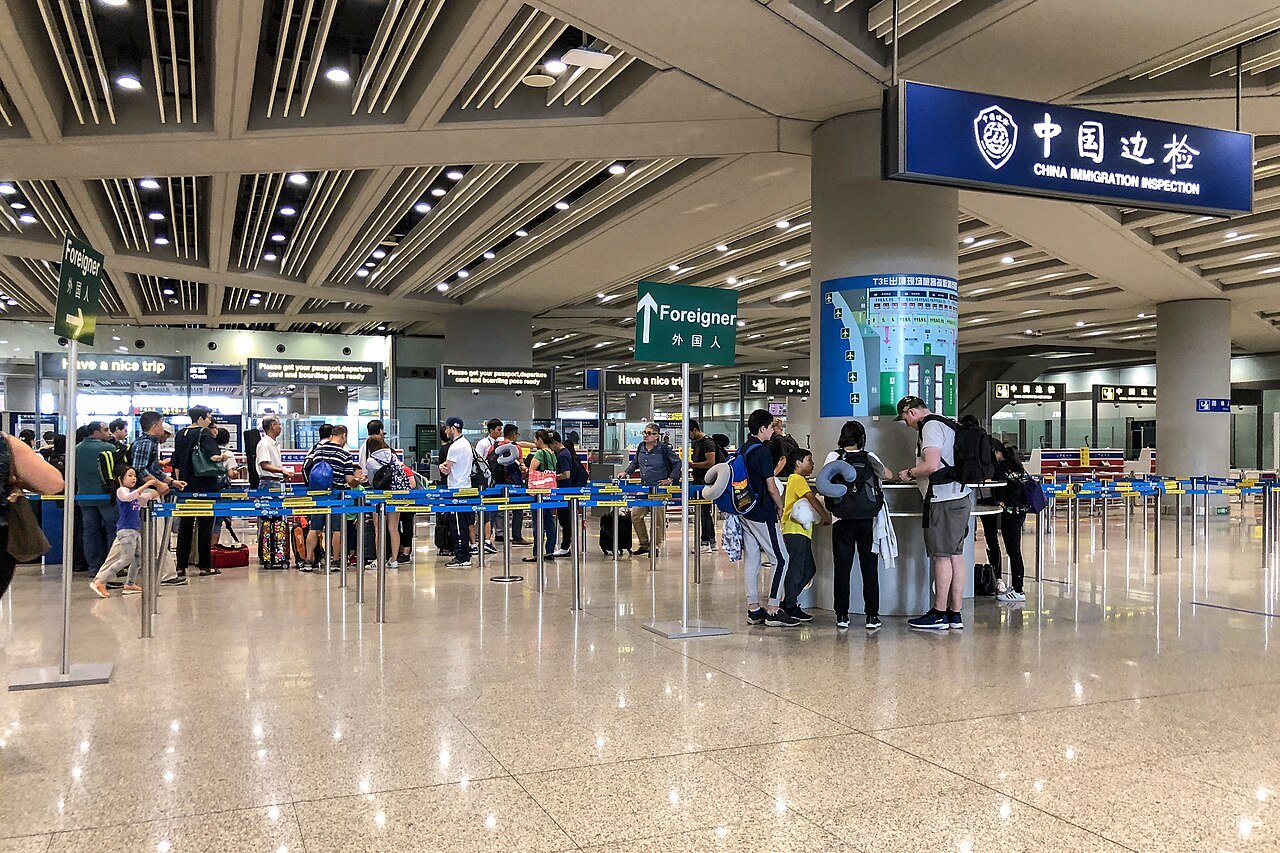
The departures immigration hall at Beijing Capital Airport, foreigner lanes on the left. Note what nobody in this photograph is doing: filling in a departure card. · Image source
It is the night before your flight home, and the internet has found your anxiety. Somewhere between the airline's check-in page and a forum thread from 2016 sits a website offering you a 'China departure card' — official-looking, faintly urgent, seventy dollars. You have never heard of this document. You filled in an arrival card when you landed, so a departure twin sounds plausible. Your card comes out of your wallet.
Put it back. Here is our honest verdict up front: there is no online China departure card, there never has been, and nobody official charges for one — the immigration authority's online system covers arrivals only, and its own published guide for leaving the country asks for your passport and nothing else. The sites selling departure cards are selling you a form that does not exist, which is at least an efficient kind of fraud.
What follows is the whole picture, including the parts that make it confusing: the paper departure stub that genuinely did exist and may still be sitting in your passport, the old regulation text that scam sites quote as proof, the official fraud warning the authorities issued in December 2025 — and the three-door simplicity of what actually happens when you leave.
At the deskPassport + boarding pass → stay validity checked → stamped out. No form, no fee, nothing bought in advance
The one exceptionArrived on a paper card? Keep its departure stub in your passport and hand it back. Arrived online? No paper exists
The only official addresses
nia.gov.cn — the National Immigration Administration. China's immigration authority. Its government site, its service platform and the 'Immigration 12367' app are the complete list of official online channels for entry formalities, and the arrival card filed through them is free of charge. If a page about Chinese entry or exit cards lives on any other domain and asks for money, it is not the government.
The arrival card is the only card with an online form. Since 20 November 2025, foreigners can file the arrival card online before landing — or still use the paper card or the self-service terminals at the port. The same announcement that created that system contains no departure card, no departure form and no departure fee, because no such product exists.
There is deliberately no booking button in this box and no affiliate link anywhere on this page. There is nothing to buy for a departure from China, and a page explaining that should not pretend otherwise.
While you're in the departure hall
Eat before the desks, not after. The full restaurants at big Chinese airports sit landside, before check-in and security; airside choice thins out fast. A proper last bowl of noodles belongs before the three doors, not between them.
Spend the small yuan down. Coins and small notes are the souvenirs nobody wants. Departure halls are full of tea shops and bookshops for exactly this — a bag of tea travels better than a pocket of aluminium.
Claiming a tax refund? Build in the minutes. Departure tax refunds for overseas shoppers run through designated counters in the departure process at the airports that offer them. If a refund is part of your plan, it belongs in your timing before you reach the airport, not discovered in the queue.
What actually happens when you leave
Three doors · Passport and boarding pass · No form, at any of them
Strip the folklore away and a departure from China is three doors. First the airline's check-in desk, which issues the boarding pass. Then security. Then exit border control, where an officer examines your passport — checking, in the immigration authority's own words, your travel document and that your stay has not overrun — stamps or scans you out, and waves you through to the gate. That is the whole ceremony, at every international airport in the country.
The proof is hiding in the official paperwork itself. The National Immigration Administration publishes a step-by-step guide for foreigners, and its two halves are not symmetrical. The arrival half instructs you, in terms, to fill in the Foreigner Arrival Card. The departure half lists what to present — passport or other travel document, formalities completed, permission to leave — and never mentions a card at all. When the authority that prints the forms writes a departure checklist without one, the reasonable conclusion is not that the form is hiding. It is that leaving was never the card's job.
Check in — boarding pass issuedSecurity screeningExit border control — passport and boarding pass, stay validity checkedAirside. That was all of it.
Where the 'departure card' went — the honest history
It existed on paper · It never existed online · No abolition notice exists either
It did exist, and honesty about that is what separates this page from the sites it warns you about. From 2007, China's paper arrival card was printed as a single form in two parts: an arrival portion, surrendered when you landed, and a departure portion, which the instructions of the time told you to keep in your passport and hand back when you left. Generations of travellers guarded that little stub across whole trips, and the internet's memory of it is why 'China departure card' still sounds like a document that must exist somewhere.
Two things then happened, neither of which was an abolition ceremony you can point to. The arrival side went digital — most recently and completely on 20 November 2025, when online arrival filing opened on the immigration authority's platform. And the departure side simply faded from the procedure: the authority's current guidance asks for documents, not cards, and no online departure form was ever created to replace the paper one. The 1995 border-inspection regulation still contains the words 'exit-entry cards', which is exactly the kind of official-looking text a fee-charging website quotes at you. A regulation mentioning a card is not a card you can buy, and it is certainly not one you can buy from them.
2007 — the paper card becomes two-part: arrival stub in, departure stub kept2025-11-20 — arrival filing goes online, free, on the NIA platformToday — departure procedure lists documents only; no online departure card exists
The one exception: the paper stub in your passport
Two kinds of arrival, two kinds of departure — and neither involves paying anyone
There is exactly one traveller for whom a departure card is a physical object, and you may be them. If you arrived in China the paper way — filling in the card by hand on the plane or at the arrival hall — you may have been left holding its second half: the departure portion, meant to travel in your passport until you leave. Travellers who filed online have no such paper; their arrival lives in the system, and their departure needs nothing to match it.
So the rule is short enough to fit on the stub itself. Paper arrival: keep the departure half, hand it back at exit control, done. Online arrival: there is nothing to keep and nothing to hand in. Either way, the stub — if you have one — came free with your arrival, and the day anyone tries to sell you a replacement is the day to remember this page.
Arrived on paper → keep the departure stub in your passportHand the stub back at exit control when you leaveArrived online → no paper exists; nothing to hand in, nothing to buy
The paid 'departure card' websites, taken apart
The arrival-card version drew an official fraud warning in December 2025 · The departure version sells even less
Now the scam, which is not really about departure at all. In December 2025 the National Immigration Administration issued a formal warning: overseas fraudsters had built counterfeit websites posing as China's official platform for arrival-card filling, and were charging travellers fees for a service the authority provides free. The warning concerned the arrival card — the card that exists. Around its edges grows the departure variant: sites and 'visa service' storefronts offering a China arrival/departure card as a paid product, with prices running to seventy US dollars, for forms that are either free or nonexistent.
The tell is always the same, and it is structural rather than visual — these sites can look immaculate. The tell is the checkout. Chinese border formalities for ordinary travellers are not sold by third parties, at any price, in either direction: the arrival card is filed free on the immigration authority's own platform, and the departure card cannot be filed at all, because there is nothing to file. A page that asks for your card details to arrange either one has told you everything about itself. Close it, and if you need the arrival form for a future trip, type the authority's address yourself: nia.gov.cn.
The pattern: an official-looking site, an urgent tone, a fee at the endThe giveaway: any charge, for either card, in either directionThe fix: official channels only — nia.gov.cn and its service platform, always free
Our call: close the tab
If a website asks you to pay for a China departure card — or for the free arrival card — it has identified itself. The immigration authority files the one card that exists for free, on its own platform, and asks for nothing but your passport on the way out. Keep the paper stub if you were given one, keep your arrival screenshot if you filed online, and spend the seventy dollars on the airport noodles instead.
Final checks
Before the airport, the genuinely important checks have nothing to do with cards. Count your stay against your visa or visa-free allowance — overstay is the one departure problem that is real, and it is far better discovered at your hotel than at the desk. Keep your arrival confirmation (the online filing screenshot, or your paper stub if you have one) in the same place as your passport until you are airside. And keep the onward boarding pass coming: no airline desk, no exit control.
Then, one sentence of humility that outranks this entire page: follow the officers at your airport. Border practice is uniform in its requirements — passport, boarding pass, a valid stay — but local procedure has local habits, and if an officer at your port hands you a form, the correct move is to fill it in, not to cite an article at them. The article's job was narrower and, we hope, already done: making sure that whatever you hand over at that desk, you did not pay a stranger on the internet for it first.