
Su Shi (Su Dongpo) died in Changzhou on 24 August 1101, aged 64, after being pardoned from exile on Hainan and while travelling toward a new posting; Changzhou tradition holds that he had long wished to settle in the city, and Dongpo Park on the canal marks where his boat was moored
Checked November 2026GUIDES / ITINERARIES
Changzhou First Time: Dinosaurs, a Poet's Last Home, and the Lakes Beyond
An hour from Shanghai, most travellers ride straight through Changzhou without stopping — which is a pity, because this is the city Su Dongpo chose above everywhere else to end his life, the scholar lane that raised the father of Pinyin, and a prefecture that runs from a 2,500-year-old triple-moated ruin to a sea of bamboo and a Taoist holy mountain. The trick is to plan it by its three geographies: the canal city, the Liyang lakes, and the Jintan hills.
City Changzhou18 min read13 facts labeledChecked 2026-11-01
Keep it in your favorites
The city the poet refused to leave
In the summer of 1101, an old man came up the canal to Changzhou and never left. Su Shi — Su Dongpo — had just been pardoned after years of exile at the empire's far edges, most recently on Hainan island, and was travelling north toward a new posting he would never take up. He had been passing through Changzhou, on and off, for four decades: friends here, family connections here, poems written here. In his last years he had asked, more than once, to be allowed to retire to this mid-sized canal city between Suzhou and Nanjing. He died here that August, aged sixty-four, and Changzhou has been quietly proud of the fact for nine hundred years. Dongpo Park, down by the canal where his boat was moored, is still where the city goes to remember him — not with a theme park, but with a pavilion, a statue, and old men playing chess in the shade.
The poet was not an accident. Changzhou spent the Ming and Qing dynasties producing examination graduates at a rate far beyond its size, and its scholar quarter survives as Qingguo Lane, a canal-side street of courtyard houses a few minutes from the modern centre. Zhou Youguang, the linguist who led the creation of Hanyu Pinyin — the romanisation system that spells every Chinese name you have ever read — was a Changzhou man from this quarter. Comb-makers worked the lane beside his, at Bijixiang, and their craft made 'Changzhou combs' a byword across the empire. Layered over that old soul is a startlingly new economy: the same prefecture builds electric cars and batteries for the world — Li Auto's first factory stands in Wujin, battery-maker CALB is headquartered in Jintan, CATL produces in Liyang — and runs the theme park that started China's dinosaur craze in 2000.
That spread is why Changzhou defeats visitors who treat it as a dot on the Shanghai–Nanjing line. It is a prefecture, not a neighbourhood: the canal city with its temple, lane and dinosaur park; then, an hour south, Liyang's lakes, bamboo forest and hot springs; then, west, Jintan's Taoist mountain and a lantern-lit resort town built in its honour. Each of the three is a genuine day. This guide builds the first-timer's version honestly — the old city read slowly, the south and west given their own logistics instead of a hopeful taxi ride, and the poet kept where he belongs, at the centre of the story.
Four days across three geographies, in running order
| Day 1, 09:00 | Tianning Temple and its great pagoda, then free Hongmei Park next door for the local morning |
|---|---|
| Day 1, late morning | Qingguo Lane's scholar houses; halls 09:30–17:30, closed Mondays |
| Day 1, afternoon | Comb Lane (Bijixiang) and the old-city canal walk; combs made here for centuries |
| Day 1, evening | Dongpo Park on the canal, where the poet's story ends; silver-thread noodles for dinner |
| Day 2 | Xinbei: China Dinosaurs Park, gate ¥260 (¥220–240 booked ahead), 09:00–17:00, Metro Line 1 |
| Day 2 option | Wujin: Yancheng's triple-moated Spring-and-Autumn ruin, with the safari park beside it |
| Day 3, Liyang | Tianmu Lake fish-head soup for lunch; Nanshan Bamboo Sea (gate ¥90) in the afternoon |
| Day 4, Jintan | Maoshan temples by day; Oriental Salt Lake City's lights after dark, ticket ¥150 |
Do it like a local
Your ticks stay on this page only. No account or personal data is sent.
How to run Changzhou, step by step
- Step 1 — Read the map first: one prefecture, three geographies
Every Changzhou mistake starts with the map, so start there yourself. The prefecture-level city administers five districts — Xinbei, Tianning, Zhonglou and Wujin forming the urban core, Jintan to the west — plus the county-level city of Liyang in the south. For a visitor these collapse into three geographies that do not mix inside one day. The canal city (Tianning, Zhonglou, Xinbei, Wujin) holds the temple, the scholar lane, the dinosaur park and the ancient ruin. Liyang, roughly 80 kilometres south, is lakes, bamboo and hot springs under low green hills. Jintan, about 40 kilometres west, is the Taoist mountain country of Maoshan. Plan one geography per day, choose a base for each — the old town for the city days, a Liyang lakeside room for the south, a night inside Salt Lake City for the west — and Changzhou stops being a pass-through and becomes a small, well-made journey of three or four days.
- Step 2 — Arrive at the right station, because Changzhou has two that matter
From Shanghai, the Shanghai–Nanjing intercity trains reach Changzhou in about an hour and deliver you to Changzhou Station, which sits at the edge of the old town — the right arrival if your hotel and your first day are in Tianning or Zhonglou. Fast trains on the Beijing–Shanghai high-speed line use Changzhou North instead, out in Xinbei District: less charming, but the sensible station for the Dinosaurs Park and for northern business districts, and connected to the centre by Metro Line 1, which opened in 2019 and runs the length of the city. Line 2 (2021) crosses it east–west through the old town, putting Qingguo Lane and Tianning Temple on the network. Benniu Airport (CZX), northwest of the city, handles domestic flights and a small set of regional ones; most international visitors will simply arrive by rail. Before booking anything, pin your hotel to the station you will actually use — the two stations are 10 kilometres apart and the wrong one quietly taxes every day of the trip.
- Step 3 — Give the temple its morning: Tianning and Hongmei Park
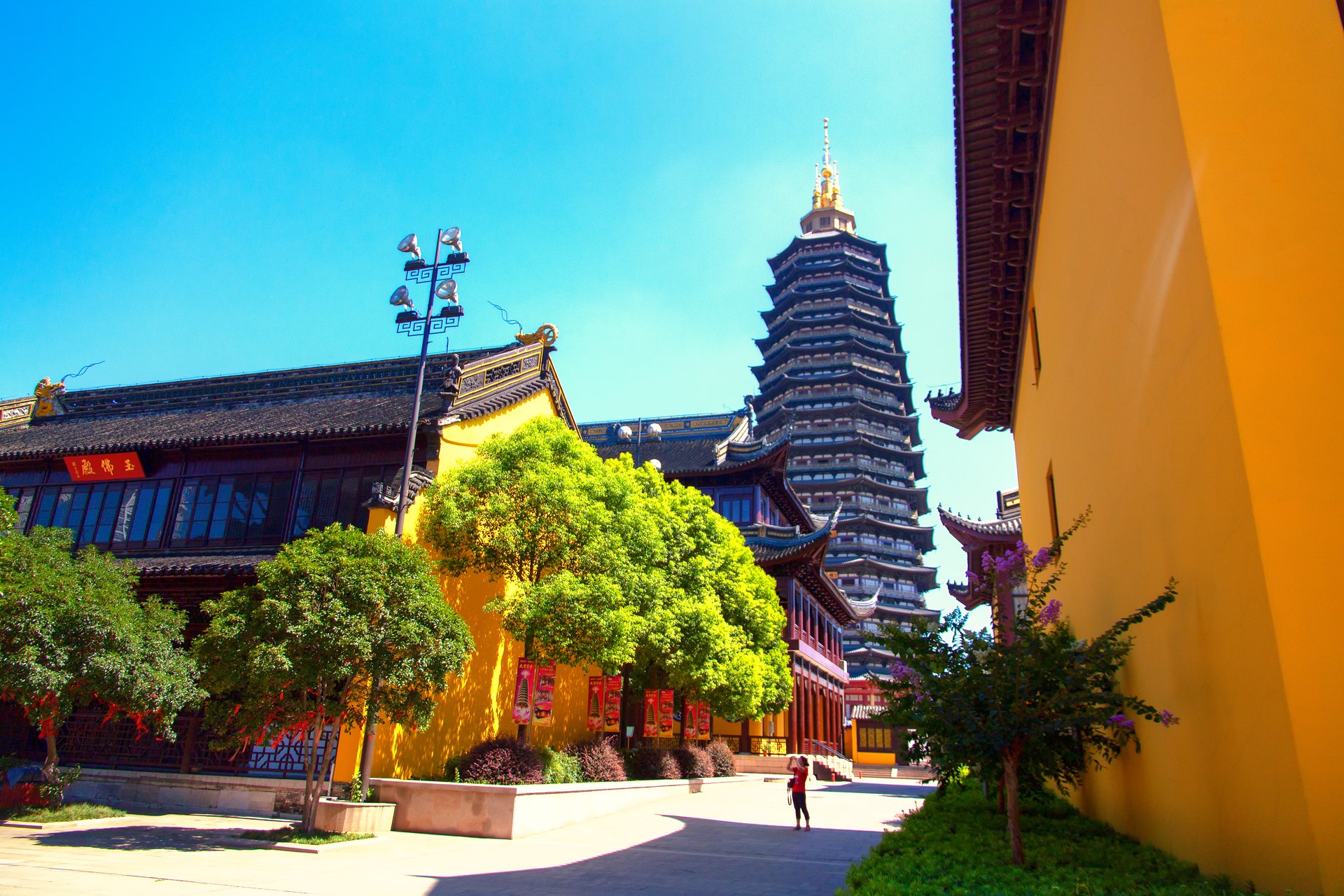
Begin the old city at Tianning Temple, in the district named after it. This is one of Chinese Buddhism's noted Chan temples, rebuilt in bright timber-and-gold style, and its pagoda — over 150 metres of stacked eaves — is the vertical landmark of the whole centre. Entry is ¥20 (07:30–16:30); the pagoda climb costs extra and is best done first, in the cool and the quiet, before tour groups thicken. What foreigners consistently underrate is the free park attached to the temple's east side: Hongmei Park, named for its red plum blossoms, is where Changzhou actually spends its mornings — tai chi on the lawns, chess under the trees, amateur opera practice by the pavilion, grandparents exercising grandchildren. Do the temple as a sight and the park as a society, in that order, and you will understand the city better by 10 a.m. than a day of monuments would teach you. The Changzhou Museum stands a short ride north in Xinbei's civic quarter — free, modern, and the right rainy-hour substitute — but it is a support act, not the morning's headline.
- Step 4 — Walk the scholar lane: Qingguo, the combs, and the poet at dusk
Late morning belongs to Qingguo Lane, reached from Wenhua Gong metro station in about five minutes. The street itself — grey-brick courtyard houses along a willow-hung canal — is free and always open, but time your visit for the halls: the preserved residences and small museums inside open 09:30–17:30 and close entirely on Mondays. This was the city's examination aristocracy in brick form, the lane that produced officials, scholars and, in the twentieth century, Zhou Youguang, whose Pinyin system now writes 'Changzhou' on every map you own. Cross to Bijixiang — Comb Lane — where workshops have cut, carved and painted wooden combs for centuries; Changzhou combs were tribute goods, and a hand-finished boxwood comb from a working shop is the one souvenir here with real lineage. Then follow the old-city canal east as the light drops to Dongpo Park, where a pavilion marks the mooring of Su Dongpo's boat. The park is small, free and entirely unforced — the correct emotional register for the place where China's most life-loving poet came ashore for the last time.
- Step 5 — Eat the old city properly, and drink its tea
Changzhou cooking sits inside the Jiangsu tradition — precise, lightly sweet, proud of knife work — and the old town feeds a first-timer well if you order its own signatures rather than generic greatest hits. Silver-thread noodles (yin si mian) are the local emblem: dough cut so fine it threads a needle, served in a clear, serious broth. Da ma gao, the sesame cake from Nandajie, is the breakfast of record; dried radish shreds and crab-and-tofu combinations appear on every honest local menu. In the Qingguo Lane and Nandajie area you are eating where the city eats, in rooms that have served the same dishes for decades — point at the local specials section, ask what the kitchen is proud of, and let lunch run long. Tea matters here too: the prefecture's hills grow well-regarded green and white teas (Liyang's white tea has its own following), and a pot of local tea with the noodles is not ambience, it is part of the cuisine. Save your appetite for spectacle, though — the prefecture's most famous dish is waiting two days south, in Liyang.
- Step 6 — Do the dinosaur park like you mean it (Xinbei family day)
China Dinosaurs Park, up in Xinbei near Changzhou North station and served by Metro Line 1, is not a garnish on the city day — it is a full day that families should give its own slot. This was China's first dinosaur theme park (opened 2000, now 5A), and its structure is smarter than the genre suggests: start inside the museum, where a nearly complete Sinosauropteryx — the feathered dinosaur that rewrote textbooks — hangs with Brachiosaurus and Hadrosaurus skeletons, because the museum is both the park's intellectual core and its least queued hour if you enter at the 09:00 opening. Then work outward to the rides: the Dinoconda 4D coaster is the headline, the Crossing Jurassic flume the family's shared memory. Book ahead online (¥220–240 typical) rather than paying the ¥260 gate price, and in summer consider the extended night session, when the park runs to about 21:00, the heat breaks and the Dino Water Town street outside the gate — free to enter, dense with food — becomes the evening plan. Beside the park, the Dino Valley hot springs make a plausible soft landing for grandparents while the children finish the rides.
- Step 7 — The other Wujin: stand inside a 2,500-year-old city (or meet its animals)
South of the centre, Wujin District holds the prefecture's oldest thing and one of its loudest. The oldest is Yancheng: not the salt city of northern Jiangsu, but a Spring-and-Autumn-period walled settlement whose three concentric moats still hold water, ring inside ring, in a pattern Chinese archaeologists describe as unique among surviving ground-level city sites of its era. There are no towers to photograph — the city is earthwork, water and reeds, read through its exhibition hall — and that subtlety is the point: you are standing in the footprint of a city plan older than the Roman Republic. Tradition ties the site to Jizha, the Wu prince who gave Changzhou its earliest fame for integrity. Immediately beside the ruin, sharing its visitor infrastructure, sits the Yancheng safari park, a drive-through and walk-through zoo that could not be more different in register. The pairing makes an honest half-day choice: scholars and photographers take the moats slowly; families with young children take the animals; groups with both constituencies split the difference and meet at the gate. Note, as you cross Wujin, the scale of its new industry — this is Li Auto's Changzhou base district — though the plants are context for the drive, not attractions.
- Step 8 — Go south properly: Liyang's lake, its soup, its bamboo sea
Liyang is a separate expedition with its own railhead: fast trains on the Nanjing–Hangzhou line stop at Liyang station, from which the lake and bamboo country is roughly a half-hour by road (treat exact times as approximate and confirm your transfer before you travel). Give the day a food-first shape. Tianmu Lake, a reservoir lake folded into green hills, is famous across Jiangsu for one dish — the clay-pot fish-head soup, a milky, pepper-warm broth built on the lake's bighead carp — and the correct first-timer's order is soup at a lakeside restaurant, then the Shanshuiyuan scenic area (¥120) for the boat-and-island version of the lake itself. In the afternoon, move to the Nanshan Bamboo Sea, where some 35,000 mu of bamboo run over the hills in green weather. The ¥90 gate is only the entry fee to the argument: the mini train (¥15 one-way), the ground cable car (¥80 return) and the chairlift (¥80 return) each take their cut, and the right strategy is to pick one mechanical assist for the ascent, walk the ridge and the panda hall at the top, and ride down. End at the Yushui Hot Spring (¥198) as the light fails, and sleep in Liyang — the lake district at night, emptied of day-trippers, justifies the room on its own.
- Step 9 — Go west to the Taoists: Maoshan and the Salt Lake City
Jintan's day belongs to Maoshan, the low, temple-dotted range that Taoism counts among its founding landscapes — this is the home ground of the Shangqing school, and its temples (the summit palaces, the grottoes, the spring said to welcome guests) draw pilgrims as much as tourists. Plan the access with care, because the mountain is administered from two cities: the famous main gate and its published tariffs (around ¥100 peak, ¥80 off-season, plus the scenic bus) belong to the Jurong side, while Jintan's own sites on the southern slopes ticket separately, and the two sides' tickets have not historically been interchangeable — recent combo passes exist, so verify at booking exactly which gates your ticket opens. From the mountain, descend in the late afternoon to Oriental Salt Lake City in the Maoshan resort area: a purpose-built, lantern-lit Taoist fantasy town of streets, theatres and water shows, with a standard full-day ticket of ¥150 and cheaper afternoon entry for the night programme. It is staged, knowingly and well — treat it as an evening at the theatre rather than a heritage site, stay in one of its inns if you can, and the town at dawn, empty and misty over its lake, will repay the room rate. Jintan town itself adds quiet footnotes for those with time: it is the hometown of mathematician Hua Luogeng and, today, the headquarters town of battery maker CALB — the prefecture's past and future sharing one small city.
- Step 10 — Leave like a hinge city: Changzhou inside a bigger delta trip
Changzhou's last virtue is positional. It sits on the densest high-speed-rail corridor on earth, roughly an hour from Shanghai in one direction and inside an hour of Nanjing in the other, with Suzhou and Wuxi as near neighbours eastward — which makes it the natural decompression stop in a Yangtze Delta itinerary: the place you insert between the mega-city and the garden cities to slow the trip down without emptying it. Budget it honestly: two days for the canal city and the dinosaurs, one for Liyang, one for Jintan is the full four-day version; with only two days, take the old city and one of the three outer days rather than compressing all of them. International visitors entering on the 240-hour transit policy can work Changzhou into a Jiangsu loop with Nanjing and Suzhou without backtracking. And when you leave, leave from the right station — old town trips end at Changzhou Station; northbound high-speed departures may belong to Changzhou North. The poet stayed forever. You, with better transport, get to promise yourself a second visit instead.
The facts this guide leans on
Changzhou is the birthplace of Zhou Youguang (1906–2017), the linguist who led the creation of Hanyu Pinyin, the romanisation system used for Chinese worldwide; his family's quarter was the scholar lane now preserved as Qingguo Lane
Checked November 2026The Yancheng site in Wujin is a late Spring-and-Autumn-period walled settlement roughly 850 metres across, ringed by three concentric systems of walls and moats; it is described in Chinese heritage sources as among the oldest and best-preserved ground-level city remains in the country
Checked November 2026China Dinosaurs Park in Xinbei District opened in September 2000 as China's first dinosaur theme park and holds national 5A status; its museum displays a nearly complete Sinosauropteryx skeleton alongside large Brachiosaurus and Hadrosaurus fossils, and the park's signature ride is the Dinoconda 4D coaster
Checked November 2026China Dinosaurs Park charges ¥260 at the gate, with online advance tickets usually ¥220–240; standard hours are 09:00–17:00, extending to about 21:00 on summer and weekend nights, and Metro Line 1 serves the park area
Checked 1 November 2026Tianning Temple, among China's noted Chan Buddhist temples, charges ¥20 for entry, open 07:30–16:30; climbing its pagoda — at 153.79 metres among the tallest Buddhist pagodas in China — is charged separately, and Hongmei Park immediately beside it is free
Checked 1 November 2026Qingguo Lane's street and canal frontage are free and open all day, but its courtyard houses and small museums open 09:30–17:30 and close on Mondays; the nearest metro is Wenhua Gong on Line 1, about five minutes' walk away
Checked 1 November 2026Changzhou's metro opened Line 1 in September 2019 and Line 2 in June 2021; the prefecture's two principal rail stations are Changzhou Station on the Shanghai–Nanjing intercity line in the city centre and Changzhou North on the Beijing–Shanghai high-speed line in Xinbei, and Benniu Airport (CZX) serves the city from the northwest
Checked November 2026Nanshan Bamboo Sea in Liyang is a 5A scenic area of roughly 35,000 mu (about 2,300 hectares) of bamboo forest; the gate is ¥90, and its internal transport is charged piece by piece — a mini train at ¥15 one-way, a ground cable car at ¥80 return and a chairlift at ¥80 return, with combo tickets sold
Checked 1 November 2026Tianmu Lake's Shanshuiyuan scenic area charges ¥120 and the Yushui Hot Spring ¥198; the lake's clay-pot fish-head soup, made with the lake's bighead carp, is the signature dish of the whole Changzhou prefecture
Checked 1 November 2026Maoshan, in the hills where Jintan meets Jurong, is a foundational mountain of Taoism's Shangqing school; its main scenic gate (on the Jurong side) publishes seasonal tariffs around ¥100 in peak months and ¥80 off-peak plus a scenic-bus fare, while the Jintan-side sites ticket separately and the two sides' tickets have historically not been interchangeable
Checked 1 November 2026Oriental Salt Lake City, in Jintan's Maoshan resort area, is a purpose-built Taoist-culture resort town rather than a historic settlement; its standard full-day adult ticket is ¥150, with cheaper afternoon and night entry sold in varying forms, and staying in its hotels commonly bundles admission
Checked November 2026Changzhou's modern industry is concentrated in the same districts this guide visits: Li Auto's first vehicle plant is in Wujin, battery maker CALB (Zhonghang/Zhongchuang Xinhang) is headquartered in Jintan, and CATL operates a major production base in Liyang — useful context for the business travellers who form a large share of the city's foreign visitors
Checked November 2026Where the Changzhou trip goes wrong
The prefecture is not a city day
Liyang is some 80 kilometres south of the old town and Jintan about 40 kilometres west, in different directions, on different rail lines. An itinerary that lists Tianning Temple in the morning, the Bamboo Sea after lunch and Maoshan at dusk is not ambitious, it is fictional. One geography per day, with its own base or its own return plan, is the rule that makes the whole guide work.
Two Maoshan gates, two cities, two tickets
Maoshan's main scenic gate is administered from Jurong (a Zhenjiang city), while its southern slopes and several sites belong to Jintan (Changzhou). Tickets bought for one side have historically not opened the other, and new combo passes change the picture season by season. Before paying, establish in writing — screenshot, booking page, gate notice — exactly which entrances your ticket covers, or expect a second purchase at a windswept ticket window.
Dinosaur park pricing has three doors and they all move
The ¥260 gate price, the ¥220–240 advance range and the cheaper night tickets are three different products wearing one name; night sessions also close rides progressively and change hours by season. Families have lost the Dinoconda to a 'bargain' evening ticket more than once. Buy the full day, a day ahead, from the park's own channels or a major platform, and screenshot the entry rules at purchase.
Qingguo Lane on a Monday is a street, not a sight
The lane's houses and museums close on Mondays and at 17:30 daily, while the street itself stays open around the clock — so a badly timed visit produces pleasant photos of locked doors and a suspicion that the guide exaggerated. The same pattern repeats across China (temples and halls keep office hours even inside 'open' scenic areas); in Changzhou, simply put the lane on a Tuesday-to-Sunday morning.
The Bamboo Sea gate price is the floor, not the bill
At Nanshan Bamboo Sea the ¥90 ticket admits you to a very large hill. The mini train, ground cable car and chairlift are separate, rational purchases that together can exceed the gate price — and walking everything is a serious half-day of climbing. Decide your combination at the entrance map, with the summit as the fixed goal, instead of discovering each pay point one surprise at a time.
Salt Lake City is theatre, not antiquity
Oriental Salt Lake City was built in the 2010s as a Taoist-themed resort town. Visitors who arrive expecting a preserved historic settlement feel cheated; visitors who arrive expecting costume streets, water shows, night lighting and a very comfortable inn have a fine time. Its prices and promotions — afternoon tickets, hotel bundles, seasonal shows — churn constantly, so treat any specific number older than the current season, including the ones in this guide, as a range to reconfirm.
Yancheng rewards readers and bores skimmers
The Wujin ruin is earth, water and geometry: three moats, low ramparts, reeds. If your group needs standing architecture to feel a site is real, the exhibition hall has to do the heavy lifting, and some travellers will still prefer the safari park next door. Split the group without guilt — the moats keep their quiet audience, the animals keep theirs, and nobody has to perform enthusiasm.
Weather runs the south and west days
The June–July plum rains make Liyang's hills lush and its paths slick in the same week; high summer turns the dinosaur park into a queue endurance event and empties the Bamboo Sea's shade of mercy by noon. Spring and autumn are the prefecture's honest seasons. In any season, hold one flexible slot in the four days — the city museum, the hot springs, a long lunch — so weather can move a day without breaking the trip.
Keep the trip moving
 China · PrepareChina Trains: Your Passport Is the TicketNo paper, no ticket window — book on 12306, verify your identity once, and board on the document in your pocket. The system is simpler than the stations are big.Verified
 Nanjing · DoNanjing First Time: The Capital That Isn'tNanjing has been a capital often enough that it stopped needing the title. What a first visit actually runs on is simpler: one forested mountain of tombs, one great museum on a timed reservation, a wall you can walk at sunset, and a river quarter that only wakes up after dark.Reference ~
 Suzhou · DoSuzhou as a Day Trip from Shanghai: One Garden, One Canal, Home by DinnerA garden, a canal street and one of China's great museums, twenty-seven minutes from Shanghai — if you book the three things that sell out and catch a specific train home.Reference ~
Sources and status
Prices, schedules and booking channels change. Recheck the details that matter before you travel.
- Wikipedia — ChangzhouVerifiedCity overview: districts and county-level divisions, Zhou Youguang's birthplace, the Yancheng triple-moated site, metro opening dates — checked 2026-11-01
- Wikipedia — China Dinosaurs ParkVerifiedThe park's 2000 opening, museum collection including Sinosauropteryx, ride list, Dino Water Town and hot springs — checked 2026-11-01
- Wikipedia — Su ShiVerifiedBiographical record confirming Su Shi's death in Changzhou in 1101 after his pardon from the Hainan exile — checked 2026-11-01
Keep it in your favorites
Something changed? Email a correction ↗