Harbin in Winter: A First-Timer's Guide to the Ice City
Updated November 2026 · Three days · The old town, two festivals and the frozen river
Keep it in your favorites
Before dawn on the Songhua River, harvest crews saw the ice into a chessboard and pry out blocks a metre and a half long. By January, those blocks are a city. · Image source
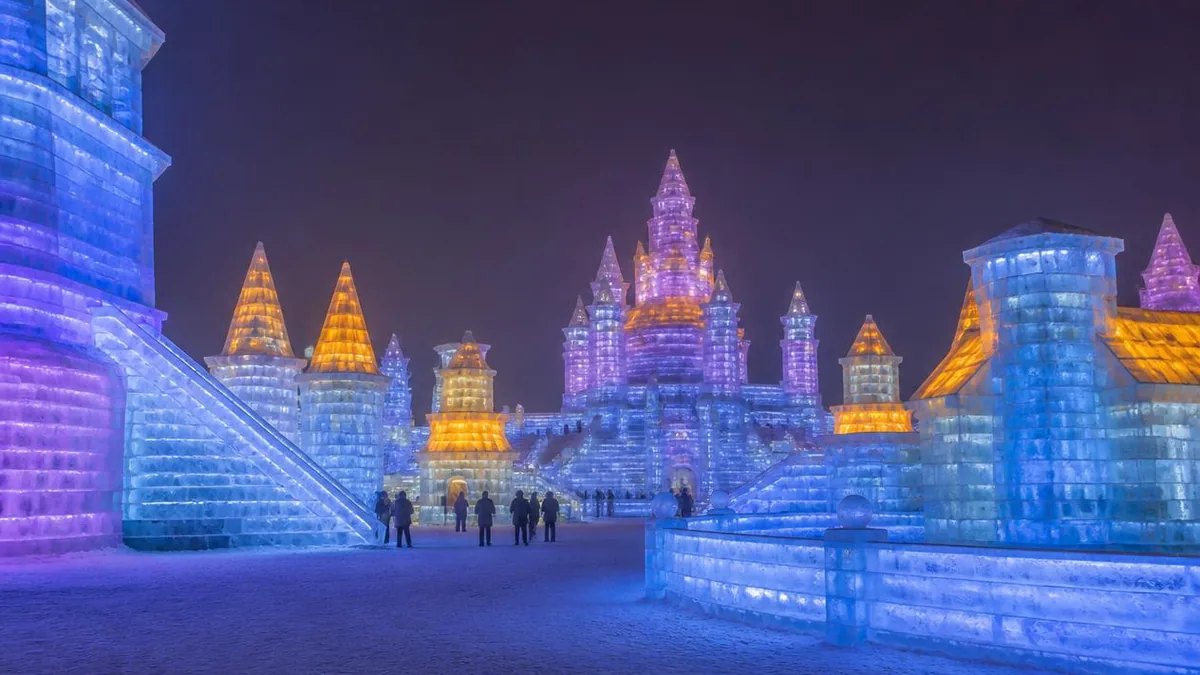
The chainsaws start before the sun does. Out on the frozen Songhua River, in the dark and in cold that has touched −27°C at four in the morning, harvest crews score the ice into a chessboard, drive their picks along the lines and lever the sheet apart into rafts of blocks — each one cut to the same measure, about 1.6 metres by 0.8. Liu Yantao, a farmer who has harvested ice for more than a decade, leads a team that cuts some 2,000 blocks a day for about three weeks. Almost every block is going to the same address: a park on the north bank where, by January, the river will be standing upright as a city of lit castles.
Here is our honest verdict up front: Harbin in winter is not a sightseeing trip, it is a short expedition with a city attached — and it is worth every layer. Two decisions decide how it goes. When you come: the parks only exist from late December to late February, and mid-to-late January is the sweet spot. And how seriously you dress: at −25°C, clothing is not comfort, it is equipment. Get those two right and this is the most astonishing winter trip in Asia.
So that is this plan. The old town first — a mile of cobblestones, a green-domed cathedral, and the small lantern fair where all of this began in 1963. Then snow by daylight on Sun Island, and the ice city after dark, entered at three in the afternoon so you see it twice on one ticket.
First · The old townCentral Street → Saint Sophia at dusk → the frozen river → Zhaolin Park's lanterns, the 1963 original
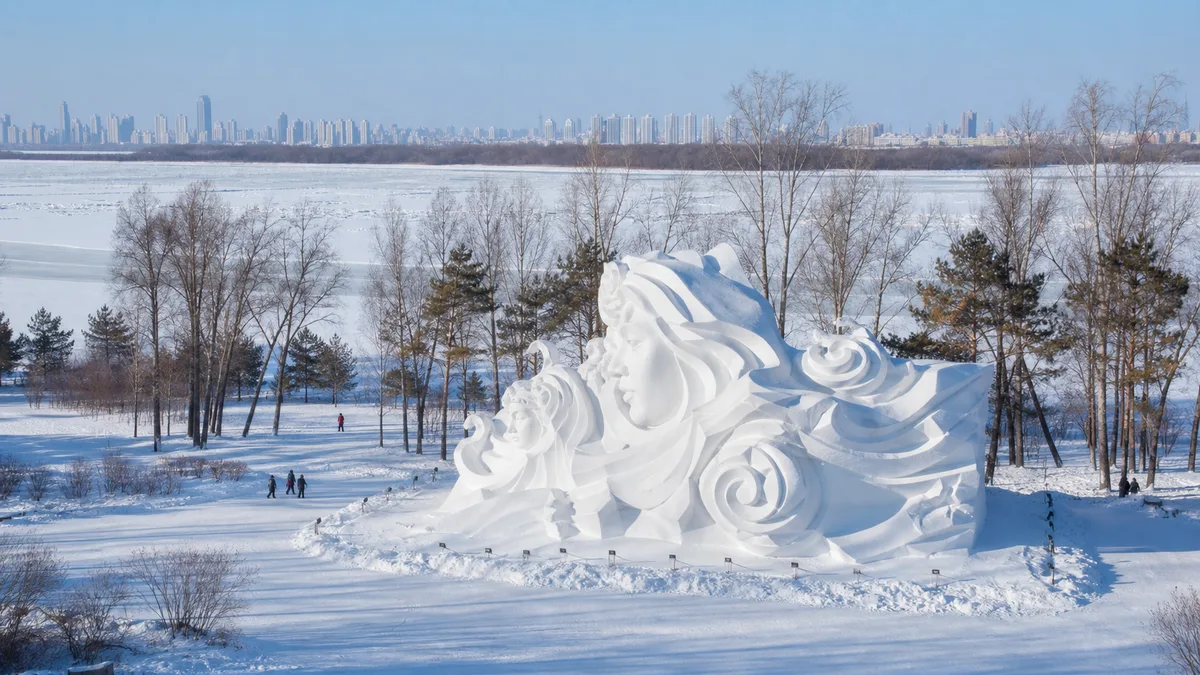
Daylight · Snow, not iceSun Island's Snow Sculpture Expo — the festival's white, daytime half
After dark · The ice cityIce and Snow World from 15:00: ice in daylight, the light-up, the 500-metre slide
Throughout · Eating against the coldGuobaorou where it was invented, a Madier pop at −25°, red sausage and an iron-pot stew
Booking priorities
The headline park announces late — plan around it. The 28th Ice and Snow World was unveiled in October 2026 as the biggest yet: 1.25 million square metres, 400,000 cubic metres of ice and snow, more than 1,000 structures, and a Frozen-themed zone built with Disney China. But the operator had not published the opening day or prices when we checked in mid-November — the last two seasons were announced in mid-December and opened days later (17 December in 2025). Booking is real-name through the park's official WeChat mini-program, with tickets typically released about a week ahead. Budget on last season's prices: ¥328 (≈$49) standard, ¥298 (≈$45) in opening week, ¥240 (≈$36) concessions, VIP fast-track around ¥800 (≈$120). And a warning worth heeding: until the operator announces, any site selling you a dated ticket is selling a date that does not exist yet.
The other three are easier. Sun Island's Snow Expo ran about ¥198 (≈$30) last season and is a daytime ticket. Zhaolin Park's Ice Lantern Fair has been free in recent seasons and usually opens around New Year. Saint Sophia's interior gallery is about ¥20 (≈$3). Hotels are the real booking pressure: January weekends go early, and Spring Festival week (5–13 February 2027) is the peak of the peak — book the bed before the ticket.
Affiliate link — booking through it supports ChinaMate at no extra cost to you. Park tickets themselves are best bought through the official channel above.
Eat — food built for the cold
Guobaorou, where it was invented Harbin's gift to the world: pork in a crackling starch crust under a sweet-sour glaze, created in this city a century ago for Russian palates and now the Northeast's defining dish. Order it wherever the dining room is full of locals — it must come to the table still crackling.
The Madier ice pop, eaten outdoors The ritual is compulsory: buy a Madier (Modern) ice pop on Central Street — the brand has sold them here since 1906, the original milk-and-egg flavour still around ¥5 (≈$0.8) — and eat it standing in the cold. At −25° the pop is barely colder than the air, it never drips, and somehow it is warming. This is not a gimmick; locals have done it for generations.
Red sausage and dalieba The Russian layer you can eat: garlicky smoked red sausage (hongchang), sliced thick, with a wedge of dalieba, the big rye loaf baked the Russian way. Qiulin and Harbin are the classic names. It is also the souvenir everyone takes home — but check your home customs rules first; many countries ban travellers from bringing in meat, so eat your fill in Harbin and gift carefully.
Tieguo dun — the iron-pot stew The Northeast's answer to deep winter: goose, pork or fish stewed in a vast iron pot set into the table, corn cakes pasted around the rim to bake in the steam. It is a group dish and a slow one — order it on your coldest night, after the ice park, and let it do its work.
How a river becomes a city
November to February — the making of the park
The build does not wait for winter. When the previous season ends, the operators stockpile the best ice — some 200,000 cubic metres of it for this year's park — wrapped in insulation, plastic and straw mats to sleep through the summer; more than 70 percent survives. Construction starts on that stored ice in late November. Then, once the Songhua freezes to about 30 centimetres, the December harvest begins: a season's ice can reach 80–90 centimetres thick, cut into those standard 1.6-by-0.8-metre blocks and trucked to the site, where roughly ten thousand builders are waiting.
The craft is older than the park. Blocks are shaved flat, set level, and joined with water — poured on the seam, it freezes the wall into a single piece of river. LED strips are laid into slots cut inside the walls before the next course goes on, which is why the buildings glow from within rather than being lit from outside. The tallest towers stand on steel frames dressed in ice. And the ending is written into the design: in late February the lights come out first, then the bulldozers push the city over and it melts where it stands. Nothing is ceremonially returned to the river — the meltwater simply finds its way home, and the only ice that survives is next year's stockpile.
Late November — stored ice starts the build, before the river is readyDecember — the harvest: chessboard cuts, rafts of blocks, trucks to the north bankLate February — lights out, push-over, and the melt, in place
Day 1 · The old town, then the original lanterns
Daoli district — everything here is walkable
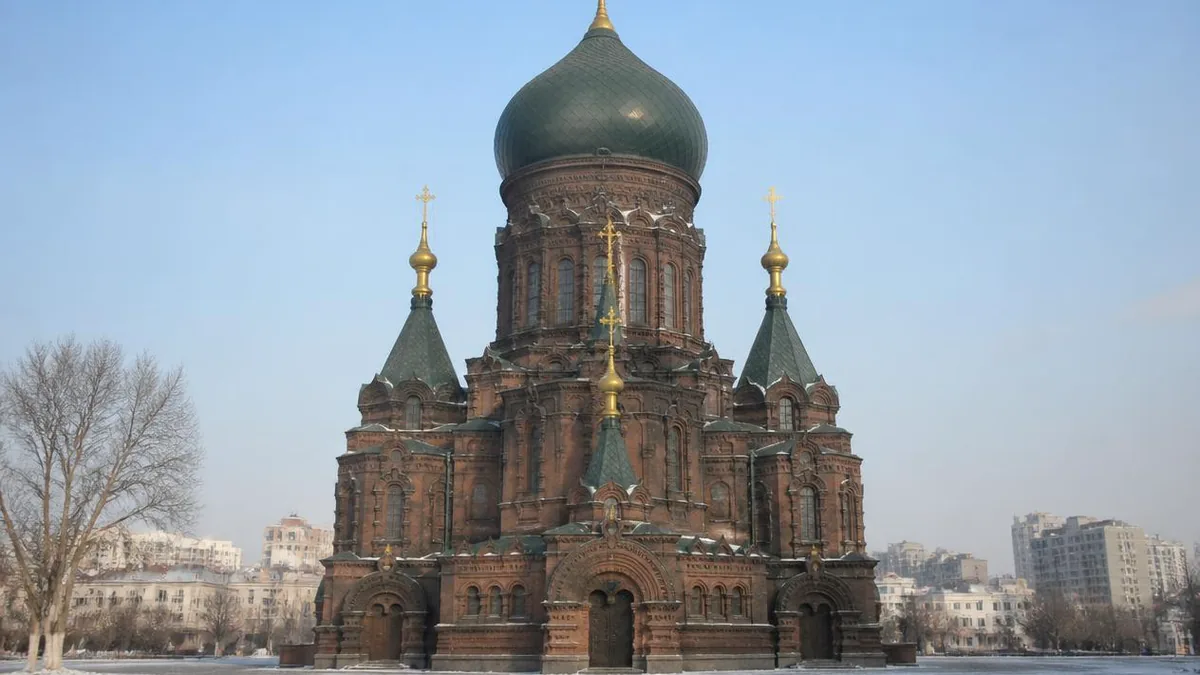
Saint Sophia at dusk — the square is free, and it is the photograph everyone came for.
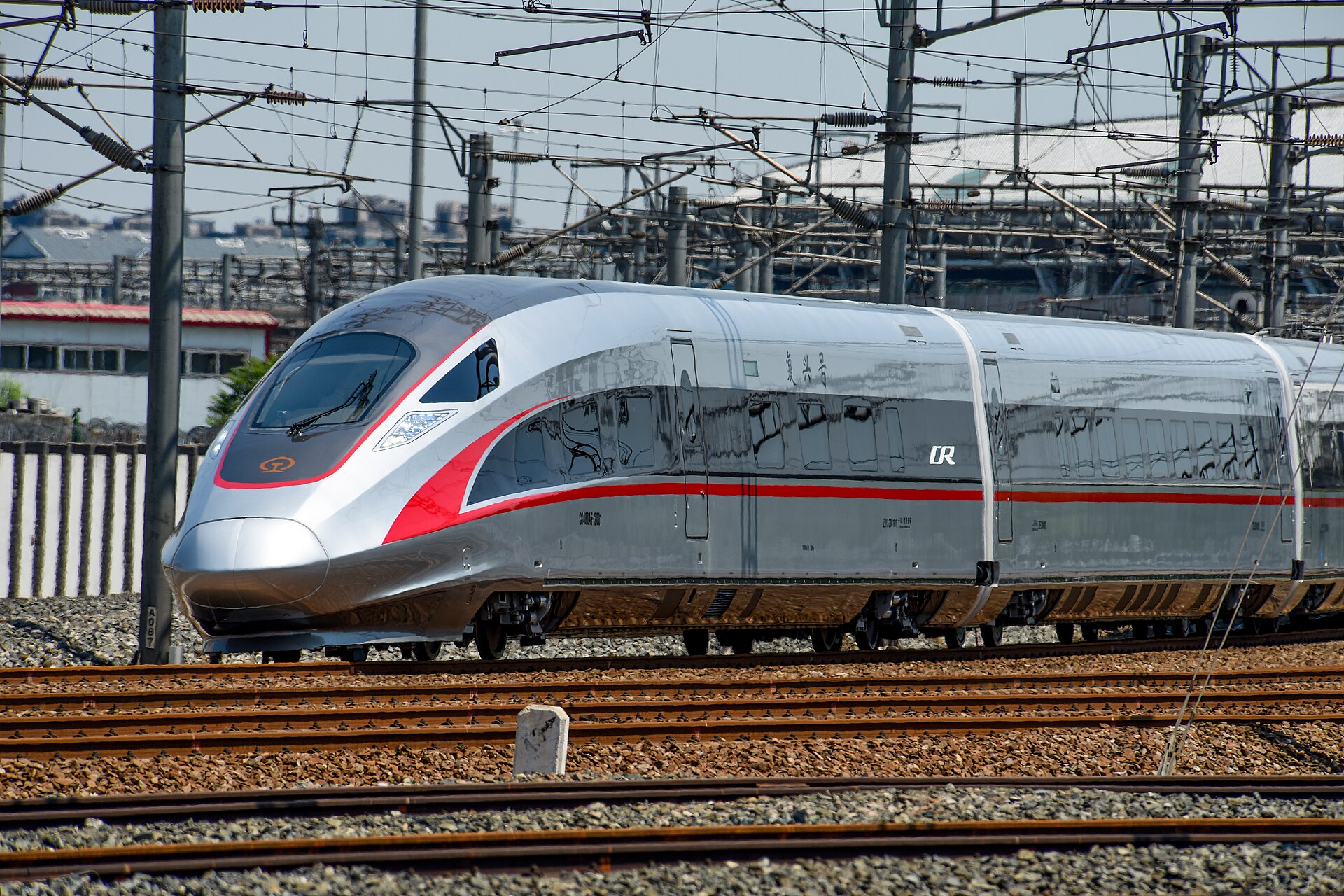
Arrive and base yourself south of the river in Daoli. The airport run takes about an hour; high-speed trains from Beijing take around five hours into Harbin West. Then walk. Central Street began in 1898 as the railway town's main street and is still a mile of cobblestones under European facades — Renaissance, Baroque, Art Nouveau — built for the Russian railway era and now the city's living room. At its north end the street simply runs out onto the frozen Songhua, where the river becomes a public playground of skating, sleds and ice bikes under the flood memorial tower.
Time the cathedral for dusk. Saint Sophia — first raised in timber in 1907, rebuilt in brick by 1932 — is Harbin's postcard: a green onion dome over red brick, now an architecture gallery inside (about ¥20 (≈$3); winter hours end in the late afternoon and it is usually closed on Mondays, so check on the day). The square is free and is the real show, best in the half hour before sunset when the brick glows. Then, after dark, do the thing most visitors skip: Zhaolin Park, ten minutes away, where the Ice Lantern Fair began it all in February 1963 — a six-day fair that drew more than 200,000 people, a tenth of the city. It is still the connoisseur's version: lanterns and small ice work at human scale, and free in recent seasons.
Central Street, south to north — end on the frozen riverSaint Sophia square for the last half hour of lightZhaolin Park Ice Lantern Fair after dark — the 1963 original
Day 2 · Snow by day — Sun Island
The festival's white half, across the river
Sun Island by day: sculpture at the scale of buildings, in snow rather than ice.
Harbin's winter is a two-part story, and the first chapter is snow, not ice. On Sun Island, across the Songhua, the Snow Sculpture Expo carves palaces, animals and whole mythological scenes out of snow — last season the expo worked with some 120,000 cubic metres of it, these days mostly machine-made and compressed into blocks the size of rooms. Where the ice park is architecture, this is sculpture: softer, huger, and made for daylight. The expo grew out of a public snow-carving competition first held here in the winter of 1988, and international teams still compete on the island every January.
Go late morning, when the light is high and the worst of the cold has eased, and give it two to three hours. The island is exposed to the river wind — dress for the ice park, not for a museum. Metro Line 2 stops at Sun Island; taxis and the cable car from the south bank are the alternatives. Last season's ticket ran about ¥198 (≈$30). Then cross back, eat something hot, and rest your legs — the evening is the main event.
Metro Line 2 to Sun Island station (or taxi / cable car across the river)The expo grounds — two to three hours, late morning into early afternoonBack across the river for a hot lunch and a rest before the evening
Day 2 · Ice by night — enter at three
Ice and Snow World, the headline act
The single best piece of timing advice in this guide: enter Ice and Snow World at about 15:00, not after dark. In daylight the park is architecture — sharp, transparent, impossibly detailed. Around 16:30 the lights come on building by building, and the same streets turn into a lit city you walk through until 22:00. One ticket, two parks. This season's edition is the largest ever announced — 1.25 million square metres on the Songhua's north bank — and the scale is real: give it four hours and plan your warm-ups, because three to four hours outdoors is what most people have in them at −25°.
Ride strategy matters more than route. The super ice slide — 521 metres last season, the park's signature — takes a QR-code queue number: scan the moment you are through the gate, because at peak the wait runs to hours, then walk the park while your number climbs. Put the 120-metre Snowflake Ferris wheel at dusk, when the whole site lights up beneath you. Between the big two, simply walk: ice maze, sculpture lanes, the shows, and the food stalls selling candied hawthorn and hot drinks. When the cold bites, rotate indoors — halls, hot food, twenty minutes — and go back out. At closing time everyone leaves at once, so know your ride: Metro Line 2 has an Ice and Snow World station at the gate; if you are taxiing, book the car before you go in and walk to the official ranks, not the touts.
15:00 — enter; scan the slide's QR queue code firstDaylight round of the big sculptures while you waitDusk — Ferris wheel as the lights come upNight round, warm-up breaks indoors, out before the closing rush
Day 3 · The slow day
Tigers, old Daowai, and one last stew
Keep the third day loose on purpose — it is your insurance against weather, a late opening, or a day-two that ran long. The classic morning is the Siberian Tiger Park, where buses drive through large enclosures of the biggest cats on earth, Harbin's other famous residents. Or cross to the old Daowai district, the Chinese-baroque quarter south of the river, for a market morning and the city's older, steamier food streets. Either way, end the trip the way the city would: a final guobaorou, a bag of red sausage and dalieba for the road — eaten or gifted within the customs rules — and a last walk on the river ice.
If the trip has a fourth day in it, spend it on the river itself: the Songhua ice carnival of slides, snow tubes and ice bikes runs all season near the old railway bridge, and it is the version of Harbin locals actually use. Save the ski resorts and Snow Village for a longer trip — they are an extension, not a day trip, and the next section treats them that way.
Morning — Siberian Tiger Park, or old Daowai's market streetsMidday — the last guobaorou, red sausage and dalieba to goAfternoon — the river ice carnival, or your train and flight out
Dressing for −25° — the section that decides the trip
January averages: −12° by day, −22° by night
First, the numbers, so you pack for the real city and not the rumour: Harbin's January average high is −11.8°C and the average low is −22.3°C; the all-time record is −38.1°C, set in 1970. River wind makes exposed skin feel colder than any of those figures. The local system is three layers — a thermal base (merino or synthetic, never cotton), an insulating mid-layer, and a windproof down shell — over insulated trousers, with boots that are both warm and grippy: on polished ice, tread matters as much as insulation. Hat, scarf and gloves are not accessories; carry a spare pair of gloves and hand warmers, because the first pair always gets wet or lost.
Electronics suffer before you do. Expect phone batteries to drain startlingly fast in deep cold — keep the phone and a power bank in an inside pocket against your body, and rotate camera batteries the same way, one in the camera and one warming in your coat. Then use the city's own rhythm: everywhere indoors is heated to t-shirt levels, so wear layers you can open fast, and plan a warm stop every hour or so outdoors. Nobody local does four straight hours outside; the park evening works because it is broken into warm intervals.
Base: thermal top and bottom — no cottonMid + shell: fleece or light down under a windproof down coatBoots: insulated, with real tread for iceKit: hat, scarf, two pairs of gloves, hand warmers, phone and power bank inside the layers
If you have five to seven days — Yabuli and Snow Village
The extension: ski slopes and the fairytale village
With a week, the northeast opens up. The classic arc runs Harbin → Yabuli → Snow Village → Jingpo Lake → Harbin. Yabuli, about three hours by road (there are high-speed trains too), is China's original ski resort: a day on the beginner-friendly slopes, then the ritual that justifies the cold — an outdoor hot spring in falling snow. Stay the night in the resort area.
Snow Village (Xuexiang) is the fairytale photograph made real: snow loaded so thick on the roofs it rounds into mushrooms, lanterns on Xueyun Street, and nights in a kang homestay — a heated brick bed that makes immediate sense at −30°. Vehicles stop at the village edge, so store the big suitcase in Harbin and carry a small backpack for two nights; two nights, not one, is what turns it from a photo stop into a stay. On the way back, Jingpo Lake's Diaoshuilou waterfall stands frozen into a single ice cascade, with winter fishing on the lake ice in season. On snow roads a private car with a driver is the standard way to run this loop, and at peak — above all Spring Festival — every bed on it books out early.
Harbin (2 nights) → Yabuli (1 night, ski + hot spring)Snow Village (2 nights, kang homestay, small backpack only)Jingpo Lake's frozen waterfall → back to Harbin (1 night)
Recommendation: go — in the January window
Aim for mid-to-late January. By then every sculpture is finished, the cold is reliable, and you are ahead of the Spring Festival surge (5–13 February 2027), when the whole country arrives and prices peak. December is quieter and cheaper, but you are gambling: opening dates land only days ahead, and in soft-opening weeks some corners are still being built. Whenever you go, you are joining one of the great urban winters — in the 2024–25 season Harbin received over 90 million visitors, according to provincial figures. The city knows what it is doing. Dress properly, book the bed early, and let it do the rest.
Final checks
Getting there is simple: fly into Harbin Taiping, or ride the high-speed line from Beijing in about five hours to Harbin West. Inside the city, Metro Line 2 is your spine — Central Street and Saint Sophia on the south bank, Sun Island and Ice and Snow World on the north. Set up Alipay or WeChat Pay and your data before you fly; our payment and eSIM guides are linked from this page's family, and the trains guide covers the ride in.
One last piece of housekeeping: recheck the park's opening announcement before you book anything non-refundable. Harbin's season is set by the weather every single year — dates, prices and even the closing day move with the temperature, and last season the park closed early in a warm spell and refunded its tickets. That is not a flaw in the trip. It is the trip: a city built out of a river, on the river's terms.
ChinaSimply — Harbin Ice and Snow World 2026-27: what's confirmed so farReference ~Careful separation of confirmed vs unannounced: opening day, prices and hours unpublished at check time; prior seasons announced mid-December, opened days later (17 Dec 2025); last season closed early, 21 Feb 2026, with refunds
ChinaTravelPlus — Harbin cluster (6 pieces)Reference ~Coverage base draft only (Ice & Snow World, 3-day city itinerary, Central Street & Saint Sophia, Sun Island, 7-day route, season news) — every load-bearing fact re-verified before use; see factcheck notes for the conflict log