Shenzhen's High-Tech Day: Test-Fly a Drone, Eat by Airdrop, Dive into Huaqiangbei
Updated November 2026 · One day · Bay side to Huaqiangbei, with the summit in town
Keep it in your favorites
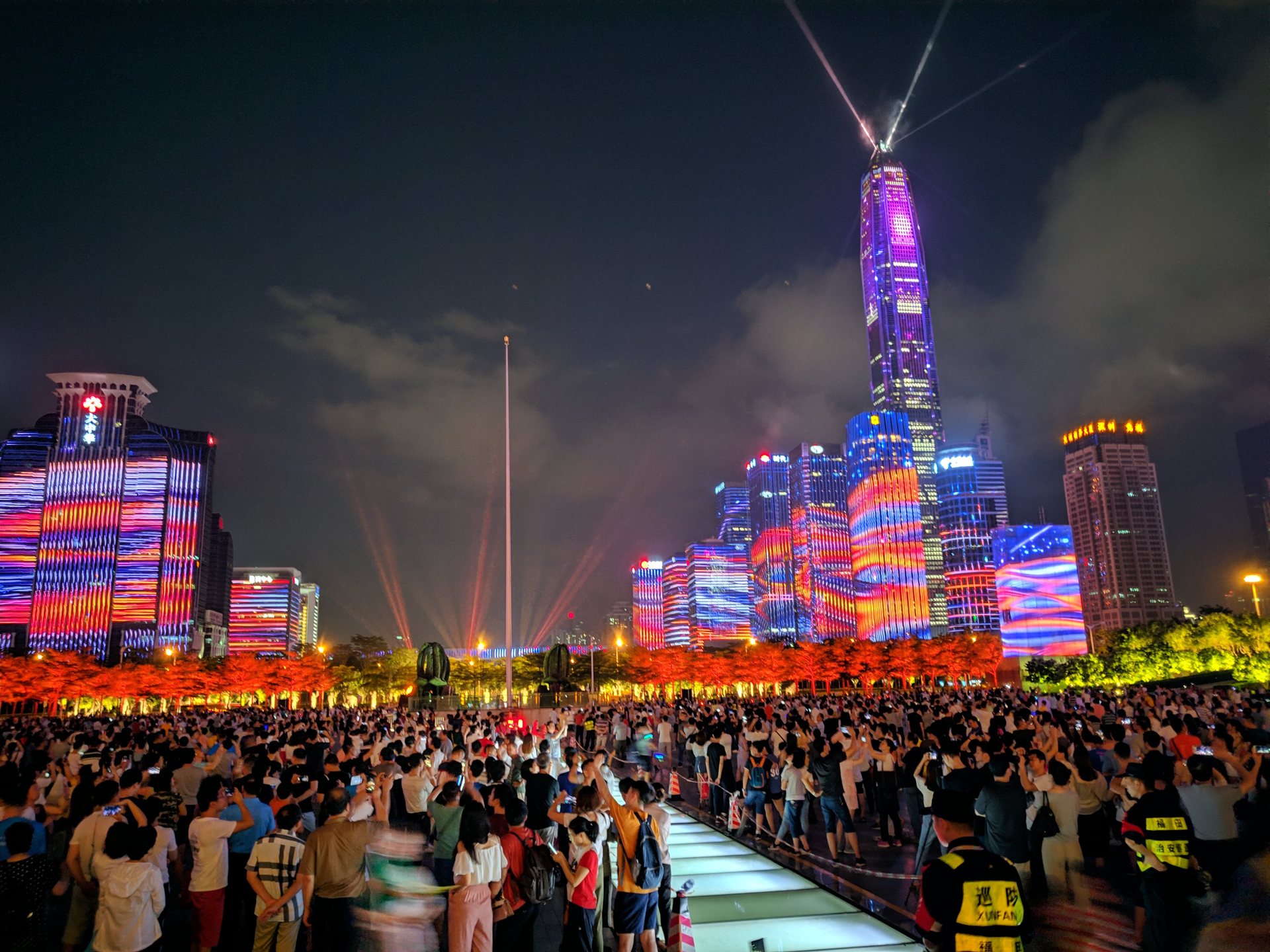
APEC week in Shenzhen: lunch lands by drone at Talent Park, and after dark the towers along Shennan Avenue light up for the summit. · Image source
It is just after one o'clock in Talent Park, and a small crowd is watching lunch descend from the sky. A drone carried a plastic box about a kilometre from the mall, lowered it into a locker, and left; the owner taps in four digits and walks away eating. When streamer IShowSpeed did this on camera, the clip circled the planet. In Shenzhen it is not a stunt — it is a delivery route.
Here is our honest verdict up front: Shenzhen is the one city where the future is not a demo but a routine — and this week the routine is wearing formal dress. APEC is in town (CEO Summit 17–18 November, leaders 18–19), the towers are lit, and the hardware bazaar never stopped for any of it.
So that is this plan. Fly a drone in the morning, eat a lunch that fell out of the sky, haggle over components in the afternoon — then watch the city light up for its guests.
Morning · The bay sideDJI's biggest store on Earth → INNO100's touchable Kickstarter hardware
Midday · Talent ParkThe drone lunch → robot-barista coffee → the sunset CCTV's hosts came for
Afternoon · HuaqiangbeiThe component bazaar → a PC built while you browse → the museum
Shopping · Three registersBay-side luxury at Shenzhen Bay MixC → border bargains at Luohu and Dongmen
Booking priorities
The drone lunch is gated by your phone, not your wallet. Meituan's air-drop delivery runs on a mainland mobile number and Chinese payment apps, set up before the day (our payment guide walks it through). Foreign cards ride fine at the malls and markets — it is the drone that wants a local number.
Everything else here is walk-up. The DJI flagship, INNO100 and the Huaqiangbei Museum are free with no booking. The one thing money buys is a guide: if you'd rather have the hardware day led, Shenzhen day tours run on Klook.
Affiliate link — booking through it supports ChinaMate at no extra cost to you. The day itself needs no ticket.
Eat — the full Shenzhen table
Lunch, by airdrop Order in the Meituan app to the Talent Park locker and be standing there when the drone comes in — about a kilometre's flight, typically 10–20 minutes. The descent is the show; the box is lunch. The park's robot barista makes the coffee after.
Dinner: coconut chicken The city's adopted signature — Wenchang chicken poached at the table in fresh coconut water, sweet and clean, dipped in sand-ginger soy. Chains like Runyuan Siji (润园四季) run it in every big mall, which makes it the easiest great dinner of the trip.
The one true local: Guangming pigeon Shenzhen had villages before it had towers, and roast pigeon from Guangming district — lacquered skin, juicy meat, eaten with your hands — is the dish locals claim as their own. Worth a detour; at minimum, order it wherever it appears on a Cantonese menu.
In season now: Shajing oysters Oysters farmed at Shajing, in the west, since the Song dynasty — and they peak from November to March, which is to say: now. Grilled with garlic or steamed, at seafood places around Shekou and Bao'an.
The bay side — touch the future
10:00, OCT Harbour and Shenzhen Bay
Start where the hardware lives. The DJI flagship at OCT Harbour is the company's largest store in the world — roughly 4,000 square metres with an indoor flight cage and an outdoor demo platform. You don't watch a Mavic here; you take one up. Entry is free, no booking — arrive at the 10:00 opening, before the tour groups.
Ten minutes along the shore, INNO100 at Shenzhen Bay Cultural Plaza (with a Bambu Lab store nearby) is the other half of the ritual: Kickstarter hardware you can finally touch — AI glasses, exoskeletons, robot dogs — and a glass wall of 3D printers running live. Tencent's twin-tower Binhai headquarters, stitched together by sky bridges, is a ten-minute photo stop on the way north.
DJI flagship, OCT Harbour — fly the cageINNO100 + Bambu Lab, Shenzhen Bay Cultural PlazaTencent Binhai HQ — pavement photo stop
Lunch falls out of the sky
13:00, Talent Park
Meituan runs fixed drone routes into more than ten Shenzhen parks. The Talent Park locker sits about a kilometre from the Coastal City malls; order, walk to the locker, and watch your meal make its approach over the bay-side lawn. It is the most ordinary miracle in China — residents don't even look up anymore.
Stay in the park afterwards. This is the same waterfront the city's APEC promo films at golden hour, and the skyline across the water is the one now lit nightly for the summit. If the day has a slow hour, it belongs here.
Order in Meituan → Talent Park air-drop lockerRobot barista coffeeThe bay-side lawn — sunset if you linger
Huaqiangbei — the bazaar that builds it all
Afternoon, Futian
Cross the city to the other pole of the same story. Huaqiangbei is an electronics market the size of a town district — tower after tower of components, cases, cameras and cables, sold by the strip, the tray and the kilo. The subdistrict counts more than 8,000 foreign visitors a day and now publishes an international-friendly services map with bilingual signage and tax refund points.
In SEG Plaza, ride the escalator past the ground floor on principle: the serious component rows and build-to-order counters sit on floors three to six. A standard PC build takes about two hours — order it first, spend those hours in the Huaqiangbei Museum (free, and genuinely good), and collect your machine last.
SEG Plaza, floors 3–6Huaqiang Electronics WorldHuaqiangbei MuseumCollect the build
Shopping — three registers
Malls, the border, and the bazaar
Shenzhen shops the way it builds: in every register at once. At the polished end, Shenzhen Bay MixC sits right behind Talent Park — luxury boutiques and Chinese designer labels, then a waterfront walk to digest. It is a different mall from MixC World in Nanshan and The MixC in Luohu; locals will assume you mean one of the three, so name it fully.
At the border end, Luohu Commercial City leans against the Lo Wu crossing to Hong Kong: five-plus floors of tailors, bags and souvenirs where bargaining is the sport — agree the fabric, the total price and the collection date before a suit is cut. One metro stop away, Dongmen Old Street is the city's oldest shopping quarter, budget fashion and street food cheek by jowl. And the bazaar end you already know: Huaqiangbei, where the souvenir shortlist is an AI translator or a drone of your own — test before you pay, and use the tax-refund points marked on its international services map.
Shenzhen Bay MixC — luxury, by the parkHuaqiangbei — electronics and gadgetsLuohu Commercial City — tailoring at the borderDongmen — budget fashion + street food
The old Shenzhen nobody posts
Nantou, the county seat this coast was governed from for 1,600 years
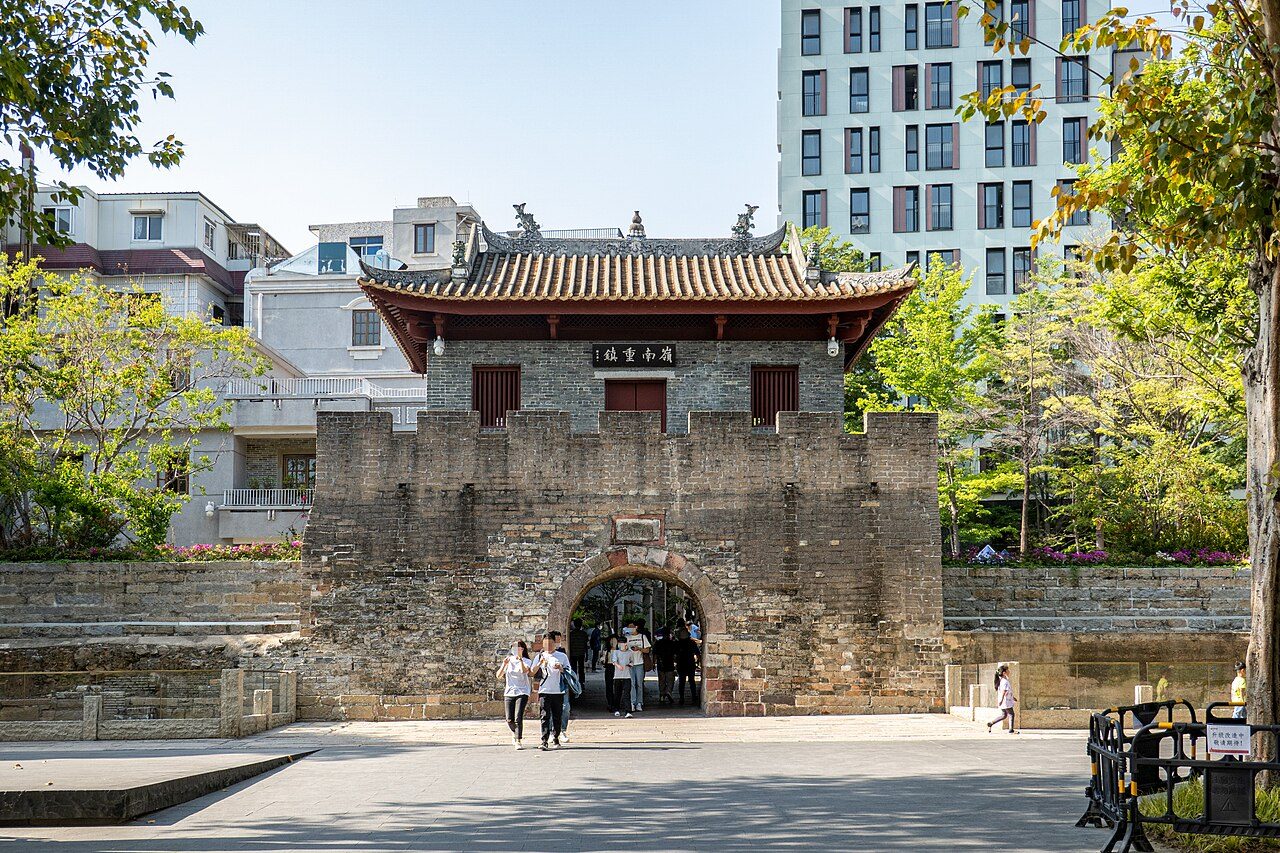
Nantou's south gate: Ming brick in front, the modern city over its shoulder.
Say Shenzhen has no history and someone will eventually answer with a photo of Gankeng, the Hakka old town in Longgang — pretty gates, hanfu rental shops, a luggage-storage sign by the arch. It is the weakest evidence available, and the sceptics know it. The stronger evidence never gets posted, because none of it photographs like a skyline. Start with the fact the skyline hides: this coast was governed from one walled town for well over a thousand years before the special economic zone existed, and the town is still standing, still lived in, one metro ride from the drone park.
That town is Nantou Ancient City, in Nanshan. A prefecture capital was set up here in 331 AD, and under its successive names — Dongguan, Bao'an, then Xin'an County from 1573 — Nantou stayed the county seat for everything that is now Shenzhen and Hong Kong until 1953. The south gate you walk through is genuinely Ming: the walled town was rebuilt in 1394 for coastal defence, and the gate's weathered stone arch faces Shennan Avenue with the traffic roaring past its feet. Inside, be honest about what you are seeing. The lanes were renovated in 2019–20 and the county office building is a modern reconstruction; what is real is the gate, the wall sections, the guild hall and temples, and the neighbourhood itself — banyan shade, coffee poured in converted village houses, laundry over lanes that follow the Ming street plan. The small Ancient City Museum, free and closed on Mondays, lays out the 1,700 years in about half an hour. Give the whole place two to three hours.
Line 12 to Nantou Ancient City station, Exit C — the Ming south gate is in front of youThe lanes, guild hall and temples, then the free Ancient City Museum (closed Mondays) — 2–3 hours
Dapeng Fortress — the other half of the argument
A Ming garrison town people still live in, 1.5–2 hours east
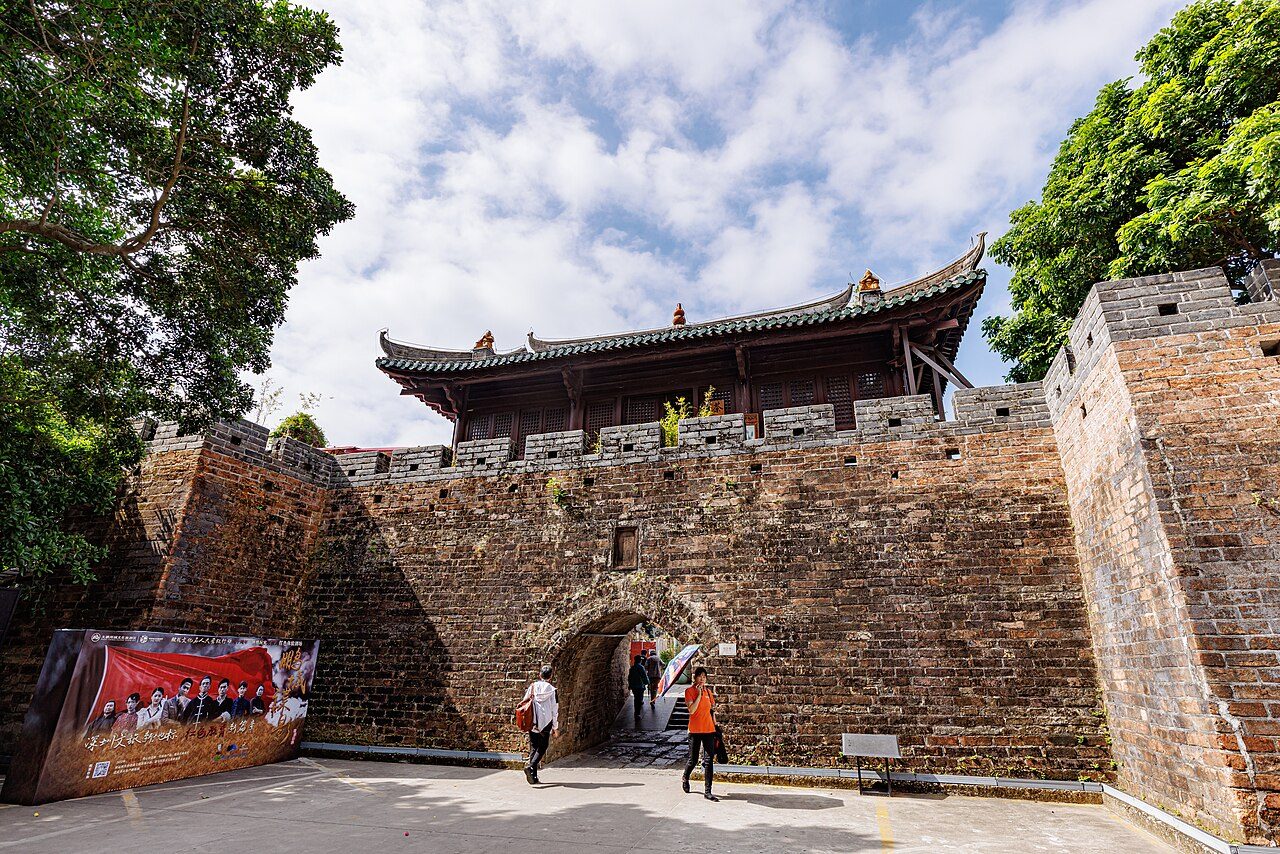
Dapeng's gate tower: 1394 brickwork, and a village still living behind it.
Dapeng Fortress is the other half of the argument, and it does not fit inside this day — anyone who tells you otherwise has not ridden the bus. Out on the Dapeng peninsula, a good 1.5 to 2 hours east of downtown, stands the garrison town the Ming built in 1394 to fight pirates: a full circuit of wall six metres high, three gates, flagstone lanes — and families still living behind them, scooters parked against 600-year-old stone. Shenzhen's nickname, Pengcheng, comes from this place. Its most famous son, General Lai Enjue, was born inside these walls and beat British warships at the Battle of Kowloon in 1839; his mansion, the finest building in the fortress, still stands. The lanes cost nothing and keep no hours; Jiaochangwei beach sits across the road for when the history is done. Treat Dapeng as the swap: trade it for the shopping section, or give it the second morning. It is the single most convincing answer to 'Shenzhen has no soul' — it just refuses to be a detour.
E11 or E26 express bus to Dapeng Center, then M471 or M457 to the Dapeng Suocheng stop, then a ~450 m walkInside: south gate → General Lai Enjue's mansion → the lanes people still live inJiaochangwei beach, across the road from the fortress, to finish
APEC week — the city in formal dress
Meeting week · 16–20 November
Visiting during APEC week? Read this part first. Shenzhen hosts the APEC leaders' meeting on 18–19 November (CEO Summit 17–18), and the city is running a full transport plan for the week of 16–20 November. If you are driving in on non-Shenzhen plates — don't, on four of those days. From 17 to 20 November, 06:00–22:00 daily, cars without a Shenzhen (粤B) plate are banned from all roads in Futian, Luohu, Nanshan, Bao'an, Longgang and Longhua — rental cars included; they are not exempt. A few expressway segments and the airport access roads are the only exceptions. Road-tripping in from Hong Kong, Guangzhou or elsewhere in Guangdong? Park outside those six districts, or switch to the train for those four days.
Public transport is the smart way in, and it is half price: metro per-ride fares are half-price on 16–20 November — day, count and ride passes are excluded, so pay per ride that week and skip the day pass, which would quietly cost you the discount — and regular bus lines are half-price too, with extra services running. Local (粤B) drivers sit under a separate, voluntary scheme — well over a million have declared they will leave the car at home that week — and flexible working is encouraged citywide, so expect security friction rather than chaos: bag checks at metro stations, temporary controls published in stages, and buffer time well spent on airport and border-crossing runs.
After dark, do what the city is doing: watch it light up. The towers along Shennan Avenue, the Futian civic centre and the Shenzhen Bay skyline run their light shows for the summit — the bay-side lawn at Talent Park and the Lianhuashan Park lookout are the classic free seats. One warning from experience: the giant drone-formation shows are festival set pieces, announced officially and often reservation-only. If there is no announcement for your date, there is no drone show — the buildings are the show.
If you have a second half-day, the districts have laid an official APEC check-in trail across Longhua, in the north: sign-your-name installations at Shenzhen North Station, the new Shenzhen Art Museum and Library at Hongshan, then the APEC-liveried tram along the Guanlan River through wetland parks. Metro and tram the whole way — the city's own party, at local speed.
Non-Shenzhen plates banned 06:00–22:00 · 17–20 Nov · six districts, rentals includedHalf-price metro (per-ride fares only), 16–20 NovLight shows — Talent Park lawn / Lianhuashan lookoutLonghua APEC trail — North Station → Hongshan → tram
Recommendation: go now, while it's dressed
Any week, this is the best one-day hardware safari in China. In APEC week it is also a city performing itself — lit towers, half-price metro, a drone in every park story and a bazaar that supplies the planet. The summit crowds are real but the city is big; run the day early-to-late and Shenzhen will show you both of its faces.
Final checks
Payments and connectivity decide how smooth this runs: set up Alipay and WeChat Pay before you fly, and sort data before landing — our payment and eSIM guides are linked from this page's family. Most of Shenzhen's hardware day is free; what it costs is metro fares, lunch and whatever Huaqiangbei talks you into.
New since November 2026: Shenzhen's metro (the full network) and nearly 900 bus routes now accept digital RMB hard wallets — tap the card-style wallet at the gate or reader, no phone or app needed. If you already hold an eligible hard wallet, it is one more way to ride. Before buying one, ask the issuing bank to confirm foreign-passport eligibility, top-up options, fees, and how any leftover balance is refunded — those details vary by product and are not yet standardised for visitors.
Coming from Hong Kong? Shenzhen is the easiest first step onto the mainland — the entering-via-Hong-Kong guide covers the crossings, and the trains guide covers the ride back down. The future, it turns out, has a commute.
Wikipedia — Nantou (historic town)Reference ~County-seat history from 331 AD (Bao'an/Dongguan), Xin'an County from 1573, Ming walled town and south gate of 1394
Wikipedia — Dapeng FortressReference ~Ming garrison town built 1394 against pirates, origin of Shenzhen's 'Pengcheng' nickname, Zhenwei General's mansion, still the lived-in Pengcheng Community
Shenzhen traffic police Q&A — APEC-week driving rules (via Sina Finance)VerifiedExplains the Shenzhen municipal government decision of 3 Nov 2026: non-粤B passenger cars banned 17–20 Nov, 06:00–22:00, on all roads in Futian, Luohu, Nanshan, Bao'an, Longgang and Longhua; rental cars not exempt; some expressway segments and airport access roads excepted. Local 粤B stop-driving is a separate voluntary declaration scheme.